
186. Grave of Lt. General Henry Marshman Havelock; Victoria Cross! (Rawalpindi)
The Victoria Cross (VC) is the highest military award given to a soldier for displaying extraordinary bravery and dedication to duty. In official words, it is awarded for:
“…most conspicuous bravery, or some daring or pre-eminent act of valour or self-sacrifice, of extreme devotion to duty in the presence of the enemy…”
It was named after Queen Victoria, the Queen of the United Kingdom of Great Britain and Ireland (1837–1901), who introduced it in 1856 after the Crimean War to honour the soldiers who performed great acts of courage and bravery in the face of the enemy.
So far, it has been awarded 1,358 times to 1,355 individuals. It was awarded to soldiers of the Commonwealth who served in the British Empire.
According to the Victoria Cross website, 14 of these recipients are buried in Pakistan, 10 of them were British stationed in India, and 4 were local soldiers. I have visited the graves of two of them, Subedar Khudadad Khan and Subedar Shahamad Khan. This was my third visit to the grave of a VC recipient.
One of the ten British recipients of the Victoria Cross who are buried in Pakistan is Lieutenant General Sir Henry Marshman Havelock-Allan, 1st Baronet, VC, GCB, DL. He was born in Kanpur, India, in 1830. His father, Major General Sir Henry Havelock, was also a distinguished military officer. Following in his father’s footsteps, he joined the army in 1846.
During the Indian Mutiny of 1857, he distinguished himself in several actions and played a notable role in the campaign to relieve the siege of Lucknow. He was awarded the Victoria Cross for his bravery in an action at Kanpur.
In his later career, he served in various military and civilian posts and, in 1874, was elected as a Member of Parliament. In 1897, while visiting his old regiment, the 18th (Royal Irish) Regiment, and accompanying them on a military expedition, he was killed by a Pathan sniper in the Khyber Pass. His body was brought to Rawalpindi and buried there. The grave is located at: 33°34’38.25″N, 73° 3’0.50″E.

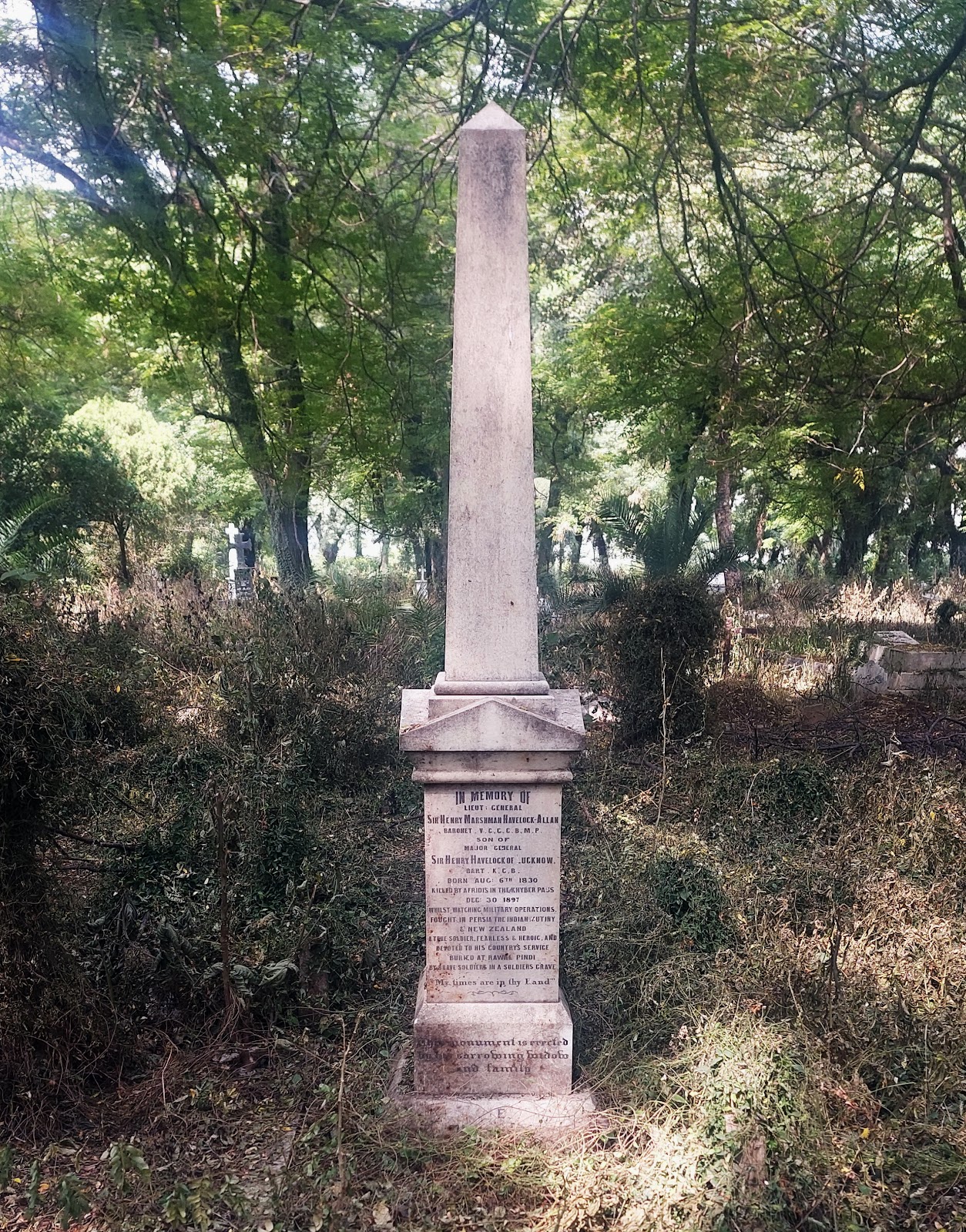
A monument on the grave of Henry Marshman Havelock. (16.09.2025.)

IN MEMORY OF
LIEUT GENERAL
SIR HENRY MARSHMAN HAVELOCK-ALLAN
BARONET V.C., G.C.B., M.P.
SON OF
MAJOR GENERAL
SIR HENRY HAVELOCK OF LUCKNOW.
BART K.C.B.
BORN AUG: 6TH 1830
KILLED BY AFRIDIS IN THE KHYBER PASS
DEC: 30 1897
WHILST WATCHING MILITARY OPERATIONS.
FOUGHT IN PERSIA THE INDIAN MUTINY
& NEW ZEALAND
A TRUE SOLDIER FEARLESS & HEROIC, AND
DEVOTED TO HIS COUNTRY’S SERVICE
BURIED AT RAWAL PINDI
BY BRAVE SOLDIERS IN A SOLDIER’S GRAVE
“My times are in thy Hand”
This monument is erected
by his sorrowing widow
and family

Another view of the grave of Havelock. (16.09.2025.)

During the British government, the graveyard was probably reserved for the British residents. But now it is mostly used by the local Christian community. However, there are still dozens of graves of the British military and civilian personnel. The picture of one of them, adjacent to the grave of Havelock, is given below.

IN MEMORY
OF
C.C.E. EWART
LIEUTENANT
5TH BENGAL CAVALRY
SON OF R.W. EWART ESQ (perhaps Esquire)
OF ELLERSLIE MOFFAT NB
WHO DIED AT RAWAL PINDI OF
DISEASE CONTRACTED ON SERVICE
ON THE 7TH JANUARY 1898

Graves of Havelock and Ewart. (16.09.2025.)

A general view of the cemetery. (16.09.2025.)

Sir Henry Marshman Havelock (Wikipedia)

The main gate of the cemetery. (16.09.2025.)
As I mentioned above, the cemetery still has dozens of graves of British officials who served in India. However, due to the recent heavy rains, the plants and grass had grown thickly everywhere. It was not possible to walk through the cemetery or read the headstones and commemorative plaques, most of which were hidden beneath the overgrowth. Besides, it was hazardous to explore it in such conditions. A caretaker advised me to come in autumn, when the site would be much clearer of plants and grass, as by then the clearing work would have been completed. Hopefully, in a couple of months, I shall visit again and discover more graves from that era. The entrance of the cemetery is at: 33°34’41.54″N, 73° 3’1.17″E.
It was surprising to see the condition of the grave of a British Victoria Cross recipient. Apparently, nobody visits it or takes any care of it. The contrast becomes even more striking when we look at the Rawalpindi War Cemetery, located less than 200 meters from this grave. The difference in care and maintenance could not have been greater.
Tariq Amir
September 29. 2025.
Islamabad