
207. St. John’s Church, Jhelum & the Mutiny of 1857!
Once, while reading about the Mutiny / War of Independence of 1857, I saw a commemorative plaque bearing the names of British soldiers who were killed in an action at Jhelum. In pursuit of that clue, I visited this church on March 30, 2014, but for some reason I could not enter it. However, it remained on my wish list, and finally I got another opportunity to visit the church on November 10, 2025. This visit proved to be successful, and I had a wonderful experience of visiting this beautiful church, my first visit of this kind.
History:
St. John’s Church, Jhelum, is one of the most significant colonial-era buildings in the city, reflecting both its rich historical past and architectural heritage. Its tall and beautiful spire is visible from a long distance, and in earlier times it was the first landmark a traveller could see, even from across the River Jhelum.
The British annexed the Punjab in 1849 after defeating the Sikhs at the battles of Chillianwala and Gujrat, both fought not far from Jhelum. Under the new administration, first Pind Dadan Khan was made the district headquarters, but the next year Jhelum was made the district headquarters of a district bearing the same name, and a military cantonment was also established here. Situated on the Grand Trunk Road, Jhelum became an important military and administrative centre.
To station army units, a cantonment was built soon after the annexation, and to cater to the religious needs of British soldiers and officers, a church was constructed nearby. The construction appears to have started in the mid-1850s, and the church was formally consecrated on February 7, 1857, by the Bishop of Madras. Consecration means the dedication of a church as a sacred place of worship.
Jhelum must have been a small town at that time, because even much later, in 1883, its population was only 21,107, with probably no local Christian community. Therefore, the worshippers would have been almost exclusively British military and civil officers.
Location:
St. John’s Church is located in the Jhelum Cantonment, in an area between the new and old Grand Trunk Road, at 32°55’16.97″N, 73°43’20.07″E. It is situated less than a kilometre from the Jhelum River, along Iqbal Colony Road. The surroundings are calm and scenic, with lush green trees spread throughout the area. The church itself stands within a spacious compound, covering an area of almost two acres.
Architecture:
The architecture of St. John’s Church is beautiful and dignified, typical of British colonial churches built in military cantonments during the nineteenth century. Constructed in solid masonry, the building reflects a restrained Gothic style. Its most prominent feature is the tall spire, which rises above the surrounding trees and makes the church visible from a considerable distance.
The church has a rectangular plan, a pitched roof, and tall arched windows along the sides, which also help in lighting and ventilation. Along the sides of the church is a series of tall, pointed arched openings, forming an arcade-like appearance. The pitched roof is covered with tiles that protect the structure from rain. The outer structure is supported by buttresses, which add to both the strength and the Gothic character of the building.

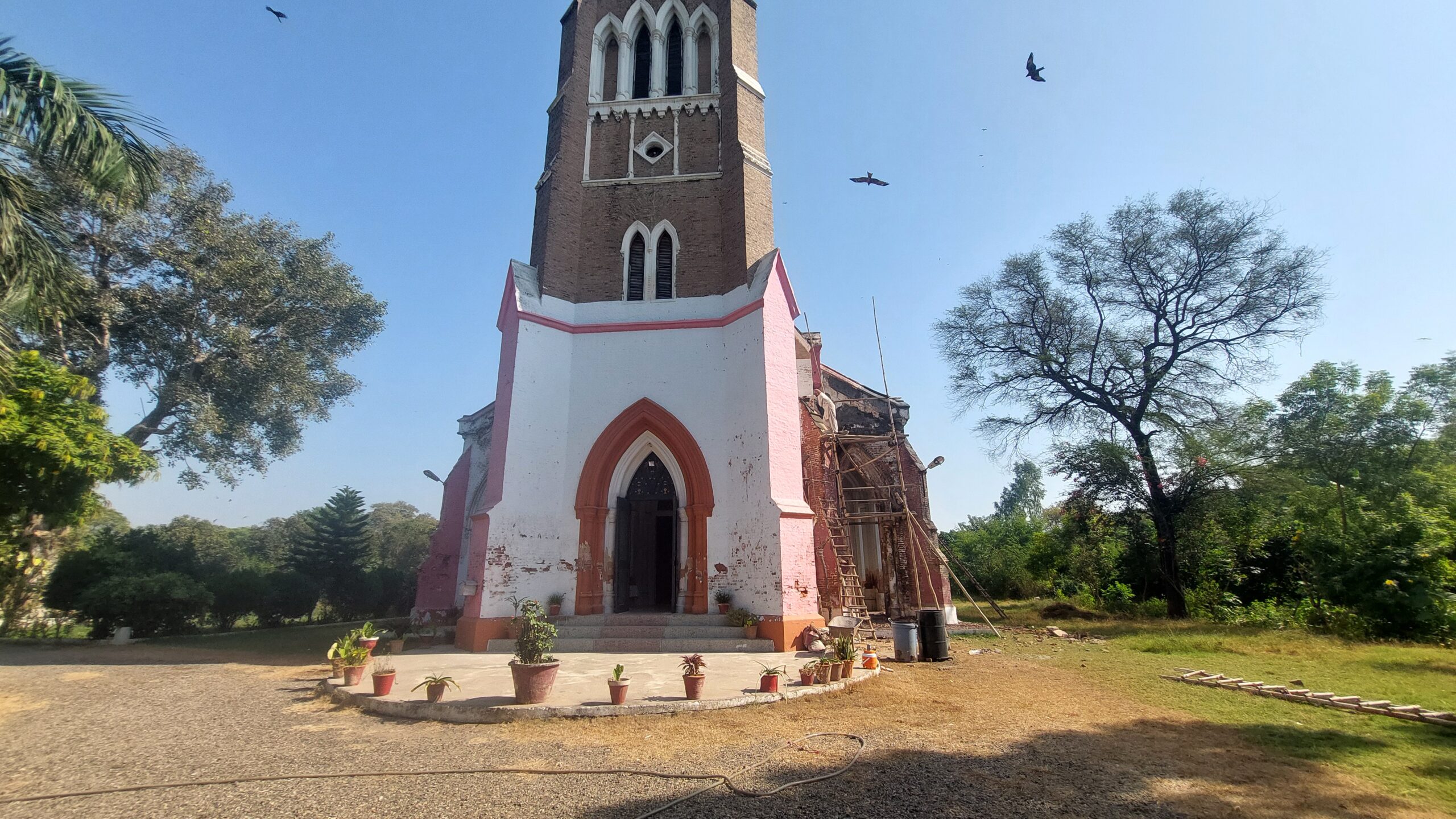
St. John’s Protestant Church in Jhelum. (10.11.2025.)
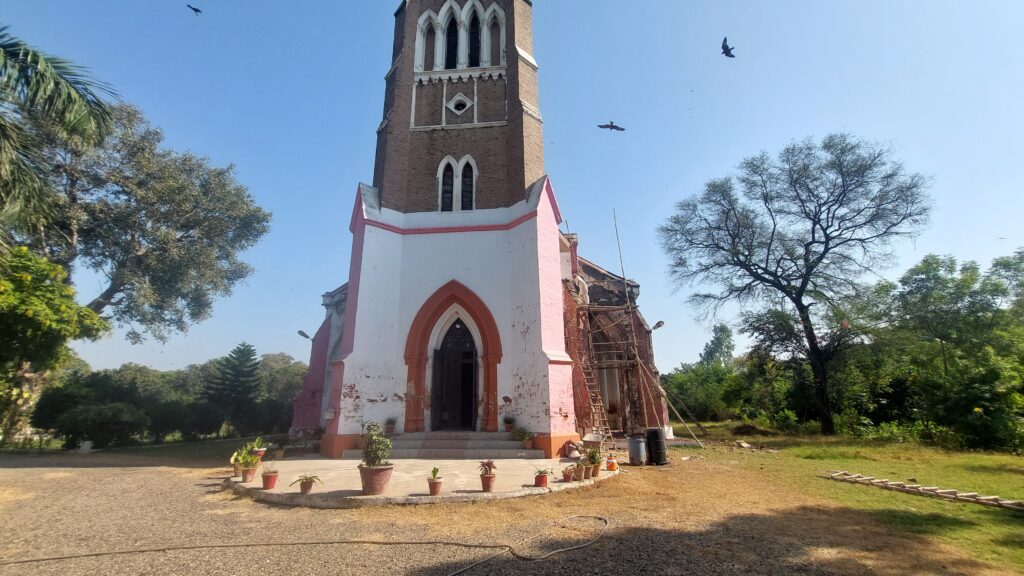
The entrance of the church. (10.11.2025.)

A closer view of the facade. (10.11.2025.)

The tall, beautiful steeple of the church. (10.11.2025.)

A side view of the church. (10.11.2025.)

The apse side of the church (the backside). (10.11.2025.)
The apse. (10.11.2025.)

Another view of the backside. (10.11.2025.)
A beautiful view of the church from the north. (10.11.2025.)

Another view from the north. (10.11.2025.)
The Interior:
The interior of the church is very beautiful. Its nave is spacious and bright, with tall arched windows on both sides that make the space airy and full of light. The pitched roof is supported by wooden beams, which add to the elegance and charm of the building. Inside, there are pews (wooden benches), a lectern, and a pulpit. The most prominent feature is, of course, the altar—a particularly beautiful part of the interior. It is raised on a platform, with a Holy Bible placed upon it and a cross adorning the back wall. This section is exquisitely decorated.
The interior of the church feels like a small museum. I felt as if I had stepped back in time and entered an era long past. Some plaques commemorate historical events, including reminders of the British Raj in India. I shall discuss this subject in more detail later.

Interior of the St. John’s Church. (10.11.2025.)

Altar of St. John’s Church. (10.11.2025.)

A closer view of the altar. (10.11.2025.)

L to R: Syed Hassan Abbas, Babu Shafiq Gill, the Assistant Pastor, Tariq Amir & Mr. Javed Manga, the accountant. (10.11.2025.)

The memorial of the war of 1857. (10.11.2025.)

The pulpit. (10.11.2025.)

A piano and a harmonium. (10.11.2025.)

Another view of the musical instruments. (10.11.2025.)
Pipe Organ:
I also got an opportunity to see for the first time a Pipe Organ. A
pipe organ is a traditional church musical instrument that produces sound by forcing air through pipes of different sizes. It is played from a console with keyboards, pedals, and stops that control the sound. In the 19th century, most pipe organs were mechanical, operated through a system of levers connecting the keys to the pipes. Besides its powerful and resonant sound, a pipe organ often serves as an impressive architectural feature inside a church.
Strangely enough, I missed taking proper photographs of this fascinating instrument. However, in the next three pictures, you can catch glimpses of it. Unfortunately, the organ is presently out of order. Babu Shafiq sahib, informed me that efforts are being made to have it repaired, but the main difficulty is that an expert capable of repairing its complex mechanism is not available in Pakistan.

Pipe organ is partially visible on the right side. (10.11.2025.)

The yellow cupboard-type thing on the left is the pipe organ. (10.11.2025.)

The organ worked with the manual rotation of this wheel. (10.11.2025.)

Pews in the church. (10.11.2025.)
The Holy Bible of the Church:
Shafiq Sahib especially showed me the church’s Holy Bible. It is a very old copy and, despite its age, remains in good condition, though the pages have become somewhat fragile. We could not find the exact date of its printing. I uploaded photographs of the Bible to Copilot, which estimated its publication to be between 1840 and 1875, based on details visible in the images, such as the style of writing, layout, and editing. It is a King James Version, most likely published by Oxford or Cambridge University Press. Undoubtedly, it is a cherished treasure of the church.

The Holy Bible. (10.11.2025.)

The Bible is kept in a glass display case. (10.11.2025.)

The first page. (10.11.2025.)

The index. (10.11.2025.)
The Steeple:
The steeple of the church is one of its most beautiful and prominent architectural features. Although I could not find any official measurements, it is quite tall and was likely once the highest building in the town, visible from a long distance. We entered the steeple via a wooden staircase and also saw its bell. The tower’s windows are shuttered and cannot be opened; otherwise they would offer a beautiful view of the surrounding area and the river. The old engineering and woodwork are particularly impressive.

The wooden stairs inside the steeple. (10.11.2025.)

From inside, the height of the steeple looks even more impressive. (10.11.2025.)

The Church Bell. (10.11.2025.)
Plaques & Inscriptions:
I have a special interest in plaques and inscriptions on old buildings because they provide the most authentic and accurate information about the building and the people associated with it. This church has about nine such plaques and inscriptions, which I am sharing here with my readers.

ST. JOHN’S CHURCHJHELUMCONSECRATED BY THE BISHOP OF MADRAS 7TH FEBRAURY 1857Thomas Dealtry (1795 – 1861) was the Bishop of Madras from 1849 to 1861.

THIS LECTERN HAS BEEN ERECTED
TO THE GLORY OF GOD & IN MEMORY
OF 35 SOLDIERS OF HM XXIV REGT.
OF FOOT, WHO WERE KILLED IN ACTION
AT JHELUM ON 7TH JULY, 1857, OR
DIED OF WOUNDS SUBSEQUENTLY, AND
WHO WERE BURIED IN THE CEMETERY OF
THIS CHURCH, BY THEIR COMRADES AND
DESCENDANTS OF THE SOUTH WALES
BORDERERS, [24TH REGT.] DECEMBER
1936.
| Rank | Name | Rank | Name |
| CAPTAIN | F. SPRING | SGT. | R. FRAYER |
| SGT. | J. PUDDICOMBE | CPL. | T. SHORE |
| PTE. | T. BALL | PTE. | C. BUCKLEY |
| “ | M. COONAN | “ | W. EARLES |
| “ | M. GUINANE | “ | C. HALFORD |
| “ | C. HELEY | “ | M. HICKEY |
| “ | J. HUGHES | “ | J. JARVIS |
| “ | R. KAVANAGH | “ | T. KENNY |
| “ | D. KAVENEY | “ | M. LANG |
| “ | J. LOONEY | “ | J. LOWRIE |
| “ | W MC GEE | “ | P. MC NIGHT |
| “ | J. MEEGHAN | “ | T. MILLAR |
| “ | H. MONTGOMERY | “ | M. MURRAY |
| “ | R. NOLAN | “ | W. RAPKINS |
| “ | W. RAVENHILL | “ | T. REDDING |
| “ | O. SILK | “ | M. STAPLETON |
| “ | G. TAYLOR | “ | P. WALSH |
| “ | G. WILLIAMS | “ |
The Military Action at Jhelum on 7th July, 1857.
The rebellion among the Indian soldiers of the British Army, then known as the Bengal Army, had already started in Meerut on 10 May 1857. It quickly spread across the entire Indo-Gangetic plains and a large part of central India. Punjab was also affected, though not as severely as some other areas. By 7 July, the troubles finally reached this cantonment, and the subsequent events, as reported by the Deputy Commissioner of Jhelum, are as follows:
The alarm at Jhelum was considerable, as there was no European force to restrain the native battery of artillery and the two regiments (14th and 39th Native Infantry). The 39th were ordered to march, without their magazines, towards Shahpur for orders. Their destination was Dera Ismail Khan, but it was an object to avoid any resistance which might have broken out at Jhelam by keeping them ignorant of their future station. They were sent down the left bank of the Jhelam, and reached Dera Ismail Khan without giving trouble. The native artillery was ordered to Lahore, and there afterwards disarmed. The only regiment which remained was the 14th Native Infantry. The Chief Commissioner resolved to disarm it notwithstanding the Commanding Officer’s assurances of its loyalty. Two companies were ordered to Rawalpindi on pretence of forming a reasure party, but in truth to weaken the regiment. This move left but 500 men at Jhelam. Early on the morning of the 7th July a force of Europeans and guns which had been sent rapidly down from Rawalpindi moved towards the parade ground of the 14th. It was joined on its way by the Sikhs of the 14th. The sepoys, seeing the advancing column at a distance, began firing on their officers, broke, fled to their lines, and there defended themselves against our fore till 1 P.M. By that time they were dislodged, and fled to a neighbouring village. This battle had, however, cost the lives of many of our Europeans. Colonel Ellice, commanding the detachment of Her Majesty’s 24th, was dangerously wounded, and Captain Spring was killed. The heat of the July sun told terribly upon the English troops. The three guns (6-pounders) proved useless against mud walls and that fortified guard-room of the 14th, and when after desperate fighting the lines were cleared of mutineers, the troops were too exhausted from heat, toil and want of food to follow up their advantage. At 4 P.M., Colonel Gerrard, who had assumed command after Colonel Ellice’s fall, order an attack on the village to which the sepys had retreated. The street fighting proved disastrous to our men; the guns were brought up too close to the houses, the gunners and horses were mowed down by the fire of the mutineers, ammunition on our side ran short, and a retreat was sounded. Two guns were brought off the field; the third, after a most gallant defence of it by Lieutenant Battye, Assistant Commissioner, in command of 30 police horse, and two or three other ineffectual attempts to rescue it, was captured by the mutineers and used against us. Both sides bivouacked on the field. Early in the morning, it was found that the enemy had fled. The forethought displayed by Major Browne, Deputy Commissioner, in removing the magazine of the 14th from their lines before the second action, probably contributed much to their speedy flight, as it deprived them of any further supply of ball cartridge. The main body of the fugitives crossed into the Kashmir territory and were subsequently surrendered by the authorities to our Government. Many stragglers were seized by the police, some were drowned, and 144 were killed in the fight. Only about 40 men of the whole 500 who opposed us remained at large. The usual precautions were taken in this district to guard against any ill feeling amongst the people.
We know the names of all the 35 soldiers killed on the British side. However, I could find the name of just one person on the rebel side. That was Mirza Dildar Baig, an officer in the 14th NI. He took command of the regiment after the rebellion and was subsequently arrested and hanged. Nothing more could be found. This information is given on the site of the Academic.
It is pertinent to mention that one of the British Gunners, William Connoly (1816 – 1891), won a Victoria Cross in this action.

To the dear memory of
Lieu. Col. Halford Fellowes Commandant 32nd pioneers.
Bordn 16th Oct. 1833. Entered into Rest
April 9th 1879, on the return march from Kandahar.
GOD PROVED HIM AND FOUND HIM WORTHY FOR HIMSELF.

IN LOVING MEMORY
OF
Clarence Edward Lees
LIEUT 34TH PIONEERS
WHO DIED AT LANDI KOTAL KYBER PASS OF
ENTERIC FEVER ON THE 13TH OF JUNE 1898
AGED 29 YEARS & 4 MONTHS
“Until the day break & the shadows flee away
Blessed are the pure in heart for they shall see God
And God shall wipe away all tears from their eyes”
THIS TABLET IS ERECTED BY A HEART BROKEN WIDOW

TO THE MEMORY
OF
MAJOR HARRY FRANCIS HOLLAND
22ND PUNJAB INFANTRY
DIED 10TH JUNE 1903
ERECTED BY
HIS BROTHER OFFICERS

TO THE GLORY OF GOD
AND IN MEMORY OF
MAJOR ARTHUR HENRY MONTAGU
21ST PUNJABIS
WHO DIED AT JHELUM ON THE 18TH DECEMBER 1907
DEEPLY REGRETTED BY HIS BROTHER OFFICERS
BY WHOM THIS TABLET IS ERECTED
D.T. SINGH LAHORE

TO THE GLORY OF GOD
AND IN MEMORY OF
Lt. Colonel H. S. Far-Strangways
DEPUTY COMMISSIONER OF JHELUM
DIED 8TH JULY 1912.
THIS TABLET IS ERECTED BY HIS FRIENDS.

SACRED TO THE MEMORY
OF
THE FOLLOWING OFFICERS 37TH DOGRAS
WHO DIED DURING THE STAY OF
THE REGIMENT IN JHELUM 1910–1914.
Major R. S. Phillips
Captain C. F. Wakefield
Captain G. F. Somers Lewis
Lieutenant G. D. Lindsell.
ERECTED BY THEIR BROTHER OFFICERS IN AFFECTIONATE REMEMBRANCE

TO THE GLORY OF GOD
AND IN MEMORY OF
MAJOR A.H.B. JOYCE, M.C.*
1ST BN. 1ST PUNJAB REGIMENT
WHO DIED AT MULTAN, WHILE ATTACHED TO
THE 2ND BN., ON THE 11TH SEPTT. 1937.
ERECTED BY HIS BROTHER OFFICERS AND
OTHER FRIENDS.
M.C.* Military Cross

It was a great honour to visit this beautiful house of God. I am thankful to Mr. Babu Shafiq, the Assistant Pastor of this church, for his kindness and cooperation. He also gave invaluable information about the history of this wonderful church.
I pray for the health and happiness of the staff of this church and its congregation.
Tariq Amir
Islamabad
0302-5041777
Nov. 10, 2025
Signature*
Signature*: My name, Tariq Amir, also serves as my signature. The second signature belongs to my friend, Syed Hassan Abbas, at the end.

The main entrance. (10.11.2025.)

“Give, and it will be given to you.”
(Luke 6: Chapter 38, Verse)
Come, let us join together to repair and whitewash the church building from the outside.
Offer your gifts and receive blessings from the Lord.
- Elder Anwar Samuel — 0334-5862570
- Pastor Parvez Akhtar — 0333-5488678
- Church Accountant Javed Manga — 0322-5854405
By: Administration, St. John’s Church, Jhelum CantonmentThe church requires considerable resources to maintain and repair this magnificent building. I thought it appropriate to share this appeal with my readers, inviting their generosity in supporting its preservation. An article in Wikipedia gives the following information about its restoration:
During the early decades of Pakistan, the garrison congregation shrank and the building was locked; it then stood unused for roughly forty years. A Pakistan Army supported conservation effort in 2007 resulted in reopening of the church for worship and for visitors. The church now falls under the Diocese of Rawalpindi* in the united Church of Pakistan and is also promoted by the Tourism Development Corporation of Punjab as part of Jhelum’s heritage trail
* Babu Shafiq Sahib told me that currently, the church was part of the Lahore Diocese.
I hope that greater efforts will be made by the concerned authorities to maintain and preserve this historic heritage building. Clearly, it is not possible for the administration alone, with its limited resources, to repair and conserve such a magnificent piece of architecture. Its preservation requires far greater resources as well as specialized expertise.
As I mentioned at the beginning, my primary interest in visiting this church was the commemorative plaque fixed inside in memory of the British soldiers killed in a battle during the War of 1857. However, the visit proved to be far more rewarding than I had expected. I realized that these colonial-era churches are important historical monuments that preserve a great deal of history within their premises. I hope to visit more churches in the future. I am especially grateful to Babu Shafiq Gil Sahib for his warm reception and for giving me such a wonderful tour of this historic and beautiful church.
Tariq Amir
December 9, 2025.
Islamabad