
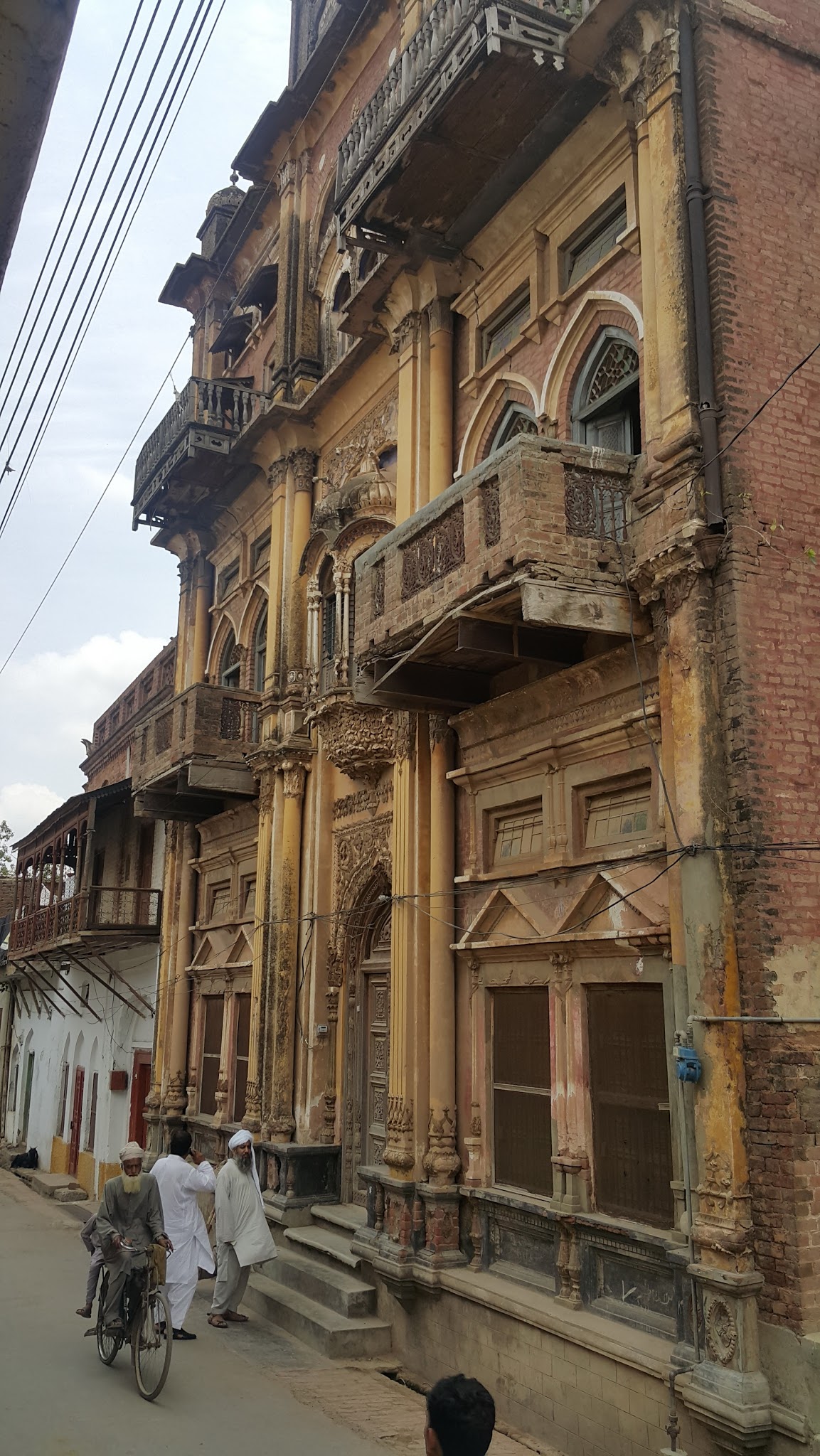
071. Krishen Niwas in Miani, Pakistan.
Miani, a small town in District Sargodha, is a very old town of Punjab. Its history goes back many centuries, and in the past, it enjoyed considerable importance as a commercial centre in this area. Due to its proximity to Pind Dadan Khan and the Khewra salt mines, it was an important centre for trade in salt.
After the collapse of Mughal authority in Punjab in the 1750s, the whole province suffered from political turmoil and deterioration in law and order. Local chiefs became independent of any central authority and competed with each other to carve out their own fiefdoms. Two factors further inflamed the situation: first, the rising power of the Sikhs in eastern and central Punjab, and second, Afghan incursions from the west. Like other areas of Punjab, Miani and the surrounding areas also suffered a lot. This is how the situation is described in the Gazetteer of the Shahpur District of 1917:
In the year 1757 a force under Nur-ud-Din Bamizai, deputed by Ahmad Shah to assist his son Timur in repelling Mahrattas, crossing the river Jhelum at Khushab, marched up the left bank of the river. Proceedings of this man may be taken as a type of the excesses committed by the invading armies; and some idea will be formed of the amount of misery caused by these inroads. Nur ud Din, finding that the inhabitants would not pay the large ransoms demanded of them, successively plundered and laid waste with fire and sword three of the largest towns of the district. Two of these, Bhera and Miani, rose again on their ruins, without however completely recovering the shock they had sustained; but of the third, Chak Sahnu, nothing remains but a mound of earth and potsherds.
According to the above-mentioned gazetteer, the Sikhs of the Bhangi Misl took control of this region after their final success against Ahmad Shah Abdali in 1767. In 1783, Maha Singh, Sardar of the Sukerchakia Misl, took control of the town from Tara Singh of the Bhangi Misl. Later on, his son, Ranjit Singh, continued his march to expand his state and took possession of Bhera and Jhawrian in 1803, then under the control of Jodh Singh.
The next important step in the expansion of Ranjit’s territories came in 1809 when he conquered two important cities of this region, Khushab and Sahiwal. The next year, he conquered Farooka and Kalowal, thus completely subjugating the area of the present-day Sargodha district. For the next four decades, this area remained a part of Maharaja Ranjit Singh’s states. In 1849, the British, after their victory in the Second Anglo-Sikh War, annexed Punjab to their Indian Empire.
I had heard about the antiquity of Miani, its wealth in the past, and its beautiful havelis. When I heard a few months ago about a particular haveli having forty rooms and beautiful wooden doors and windows, I decided to visit it. On 29 June 2017, I reached this town to explore it myself. Through a mutual friend, Malik Sikandar Khan, we had already informed the owner of the haveli about our visit. The haveli is located at 32°31’49.56″N, 73°4’30.88″E.

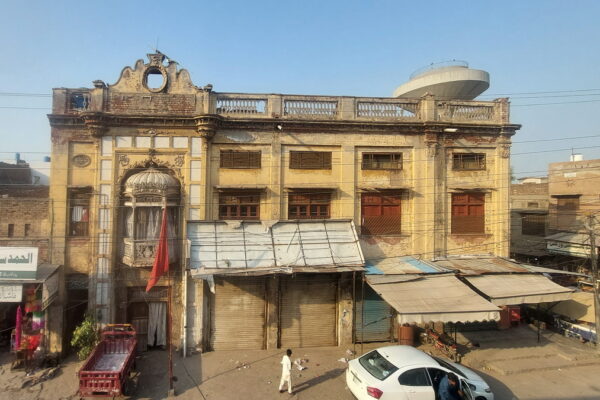
Krishen Niwas in Miani. (29.06.2017.)

Beautiful wooden door of Krishen Niwas. (29.06.2017.)

Facade of Krishen Niwas. (29.06.2017.)

Another view of the facade. (29.06.2017.)
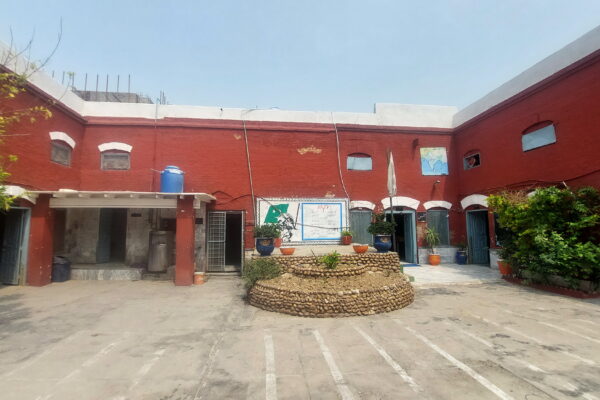
It was a hot and humid summer day. The owner of the house, Dilawar Hussain Rana, was expecting us and received us warmly. He took great interest in our questions and showed us his haveli in detail. The ground floor is rectangular in shape, with a verandah in front of the rooms on three sides. The walls, arches, and pillars are painted in red and yellow. This contrast looks quite attractive. The condition of the ground floor is not very good; however, repair work is going on.

A view of the ground floor. (29.06.2017.)

Another view of the ground floor. (29.06.2017.)

Windows in a room on the ground floor. (29.06.2017.)

A fireplace on the ground floor. (29.06.2017.)

A painting of deities on the ceiling. (29.06.2017.)

Beautiful ceilings of a room. (29.06.2017.)
Dilawar Hussain could not tell us much about the history of the haveli or its original owners, who migrated after the partition of the country. His own family had migrated from Ramba, ten kilometers north of Karnal in Haryana. His grandfather, Noor Muhammad, was the zaildar of that area. Regarding the haveli, he told us that no one had a strong enough claim to acquire it after the partition, so the government auctioned it in 1958. His father, Zakir Ali Rana, bought it at the auction for Rs. 40,000. They had to spend an additional Rs. 10,000 to have it vacated by squatters. Zakir Sahib was the principal of the Government College Bhagtanwala.

Dilawar Hussain Rana (left) and Malik Sikandar Khan. (29.06.2017.)

A beautiful room on the first floor. (29.06.2017.)

Ventilators in a room. (29.06.2017.)

Probably a Hindu religious symbol. (29.06.2017.)

A view of the first floor. (29.06.2017.)

A view from the first floor of the haveli. (29.06.2017.)

Windows of a room. (29.06.2017.)
As we have seen above, the condition of the first floor is very good. Everything, including doors, windows, ventilators, and cupboards, is in its original condition. After serving us tea and having a brief chat, Dilawar Sahib took us to the roof of the house. The roof has two beautiful structures opposite each other, each containing two rooms. This haveli is still the tallest building in Miani. I wonder how magnificent it must have looked when it was originally constructed.

Two rooms on the eastern side of the roof. (29.06.2017.)

Two rooms on the western side of the roof. (29.06.2017.)

A room on the second floor. (29.06.2017.)

A fireplace. (29.06.2017.)

A wooden staircase on the top floor. (29.06.2017.)

A view of the top floor. (29.06.2017.)

A view of Miani, with the Salt Range in the background. (29.06.2017.)

View of the old Sabzi Mandi, from the haveli. The spire of an old Hindu temple is visible in the centre right. (29.06.2017.)

A view from the highest point of the haveli. (29.06.2017.)

An old house in front of the Krishen Niwas. (29.06.2017.)

A view of the Krishen Niwas from the ground of the old Sabzi Mandi. (29.06.2017.)
During my visit I could not find much about the history of the haveli or its original owner. However, I found the following information in Wikipedia:
Pre-partition, there were also many Hindu Brahmin families living in Miani. There were Gosain Brahmins of six clans, some of which are Balak-nathiye, Dabre, Bhature. The details are available with Purohits at Haridwar, India, a most holy place for Hindus on the banks of holy river Ganges. They were living, before partition, in and around Jhikki Gali of Miani, which was near a ‘Roni Khui’ or a well. These Gosain families would marry their children into Bagge, Kapooriye Saraswat Brahmins of the region. Other Brahmin families of Miani were Mohyal Brahmins, mainly Dutt. A very large house belonging to a Dutt family still stands tall in Miani with the name ‘Krishen Niwas’ inscribed in Hindi on the elaborately carved, large wooden doors (for which Miani & Bhera were famous). This door has also engravings of Lord Krishna, lotus etc.
The visit, by all means, was pleasant. We met Dilawar Hussain Rana, a man of knowledge and experience. He is an advocate by profession and is very conscious of the haveli’s historical, cultural, and architectural value. He recently convinced his brothers to cooperate in its renovation, not an easy task. He expected the renovation to cost them more than 2 million rupees. Unlike many other such havelis and buildings, this is a success story. Dilawar Sahib invited me to visit the haveli again after the completion of the renovation. Now, I am eagerly awaiting my next visit to this haveli.
Tariq Amir
October 14, 2017.
Doha – Qatar.