I am a student of history with a strong interest in heritage and cultural landmarks. Through this blog, I document historic buildings, old institutions, and lesser-known sites in a simple and informative manner.
During the last few years, I came across some articles in Dawn etc., about the significance and historical importance of a school in the city of Chakwal. Hence, I marked it for my visit and further research. This school was established in the beginning of the twentieth century by the local Sikh community. It is a great milestone in the history of educational institutions in Chakwal, then part of the district of Jhelum. Its story also reflects the important role played by local communities, particularly the Sikhs, in promoting education in the region.
After visiting two historically important schools of a similar nature a few months earlier, my interest in this school increased significantly, and finally an opportunity presented itself on May 14, 2026. It was a warm and sunny day, but it did not dampen my spirits, and the visit proved to be both enjoyable and fruitful. As I approached the school, I was eager to see how much of its historic character had survived the passage of time.
History:
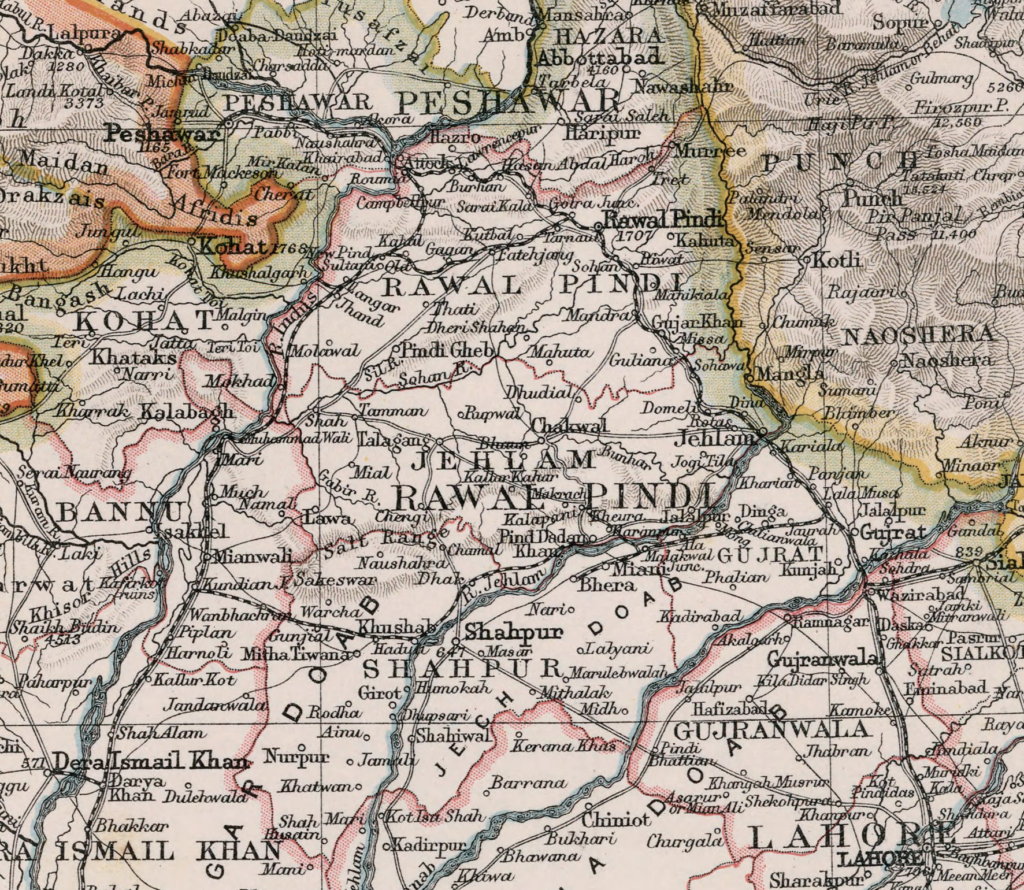
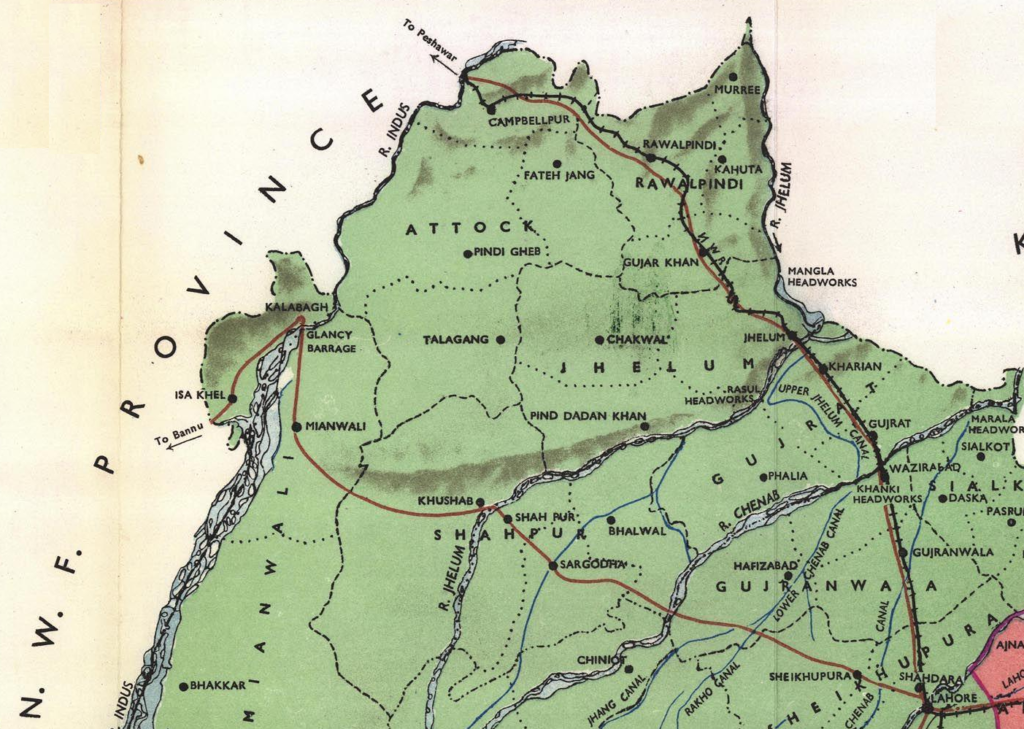
Before writing about the school, I feel it is pertinent to discuss the history and demographics of this region briefly. Being situated in the northernmost part of the Indian subcontinent and lying in the path of successive Muslim invasions, this region came under Muslim rule quite early, at the beginning of the eleventh century, when Sultan Mahmud of Ghazni defeated the Hindu Shahi ruler Anandapala at Chach, near Hazro, in 1008. Chach is a plain in the Attock District, approximately 110 kilometers north of Chakwal. The rule of the Delhi Sultanate continued until the invasions of Babur in the early sixteenth century.
Mughal rule lasted until the early 1750s, when the Mughals lost western Punjab to the Afghans and the eastern parts to the Sikh misls. The contest between the two powers continued for many decades. The Sikhs entered this region after defeating the famous Gakhar chief Muqarrab Khan near Gujrat in 1765. Thereafter, their control gradually extended northwards and westwards. The final resistance was subdued by Maharaja Ranjit Singh when he captured the last stronghold of the Janjuas, the strategically located Fort Kusak, in 1810 and forced the last ruler, Sultan Fateh Muhammad, to leave the area and settle in Haranpur.
British rule formally began in Punjab in 1849 when, after defeating the Sikhs in the Second Anglo-Sikh War of 1848–49, the British occupied the province. On 29 March 1849, they issued a proclamation annexing Punjab to the British Indian Empire.
Demographics:
Before Independence, this region, i.e. the districts of Jhelum and Rawalpindi, like other parts of Punjab, was religiously diverse. Though Muslims were in an overwhelming majority, Hindus and Sikhs also formed a considerable portion of the population. Their presence was particularly prominent in towns and larger villages, where they constituted a greater proportion of the population than in the surrounding rural areas. Being generally better educated and more actively involved in trade and commerce, they were often more prosperous. For these reasons, they played a significant role in the social, educational, and economic development of the region. Here, I shall focus on the demographics of the district of Jhelum, of which Chakwal formed a part before Independence.
After the annexation, the new administration divided the Potohar region and the Salt Range into the districts of Jhelum and Rawalpindi. Chakwal remained a tehsil of Jhelum District until 1985, when Talagang, a tehsil of Attock District, was merged with Chakwal Tehsil to form the new district of Chakwal. Find below the population statistics for the district Jhelum and its four Tehsils.
A census of Jhelum District was conducted in 1868, and the population was recorded as 500,988. It should be kept in mind that at that time the tehsil of Talagang was also part of Jhelum District. However, a more comprehensive census was conducted in 1881. The tables given below will help in understanding the religious composition of the district in 1881 and 1941. These two censuses are particularly significant, as the former was among the earliest detailed censuses of the district, while the latter was the last census of a united Punjab before Partition, after which the Hindus and Sikhs migrated to India.
Population of the District & Tehsils of Jhelum (According to the Census of 1881)
Dist./Teh.
Total
Muslims
%
Hindus
%
Sikhs
%
Jhelum (D)
589,373
516,745
87.68
60,949
10.34
11,188
1.90
Jhelum (T)
174,169
152,916
87.80
17,465
10.03
3,424
1.97
P.D. Khan
166,186
143,273
86.21
21,713
13.07
1,091
0.66
Chakwal
154,144
134,534
87.28
14,487
9.40
5,122
3.32
Talagang
94,874
86,022
90.67
7,284
7.68
1,551
1.63
Population of the Towns of the District Jhelum (According to the Census of 1881)
Towns
Total
Muslims
%
Hindus
%
Sikhs
%
Jhelum
21,107
11,369
53.86
7,966
37.74
1,460
6.92
P.D. Khan
16,724
10,001
59.80
6,419
38.38
246
1.47
Lawa
6,245
5,859
93.82
289
4.63
79
1.27
Talagang
6,236
4,174
66.93
1,205
19.32
845
13.55
Chakwal
5,717
3,279
57.36
2,045
35.77
393
6.87
Bhaun
5,080
3,262
64.21
1,604
31.57
214
4.21
Jhelum 1893
The census of 1941 is of particular significance, as it was the last census conducted in a united India before the partition of the subcontinent into India and Pakistan in 1947, an event that led to the mass migration of populations across the newly created borders.
It should be noted that in 1904, the new district of Attock was formed by combining Talagang Tehsil of Jhelum District with the tehsils of Attock, Pindi Gheb, and Fateh Jang from Rawalpindi District. However, for the benefit of the readers and for comparison between the two censuses, I have included the figures for Talagang Tehsil and the town of Talagang. Unfortunately, I could not find the population statistics for Lawa, a town in Talagang Tehsil, in the census of 1941.
Population of the District & Tehsils of Jhelum (According to the Census of 1941)
Dist./Teh.
Total
Muslims
%
Hindus
%
Sikhs
%
Jhelum (D)
629,658
563,033
89.42
40,888
6.49
24,680
3.92
Jhelum (T)
225,241
200,269
88.91
15,341
6.81
8,720
3.87
P.D. Khan
192,770
174,864
90.71
15,411
7.99
2,395
1.24
Chakwal
211,647
187,900
88.78
10,136
4.79
13,565
6.41
Talagang*
136,516
125,512
91.94
7,615
5.58
3,380
2.48
Population of the Towns of the District Jhelum (According to the Census of 1941)
Towns
Total
Muslims
%
Hindus
%
Sikhs
%
Jhelum
33,191
19,416
58.50
8,936
26.92
3,950
11.90
P.D. Khan
11,445
7,803
68.18
3,318
28.99
305
2.66
Talagang*
8,828
5,658
64.09
2,064
23.38
1,102
12.48
Chakwal
11,835
6,684
56.48
2,799
23.65
2,388
20.18
Bhaun*
6,608
4,494
68.01
1,552
23.49
562
8.50
Jhelum 1947
Location:
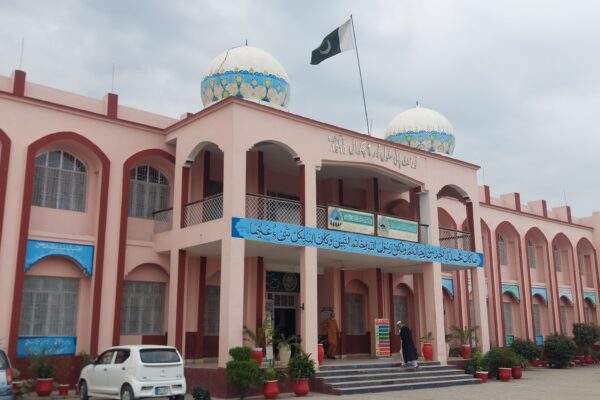
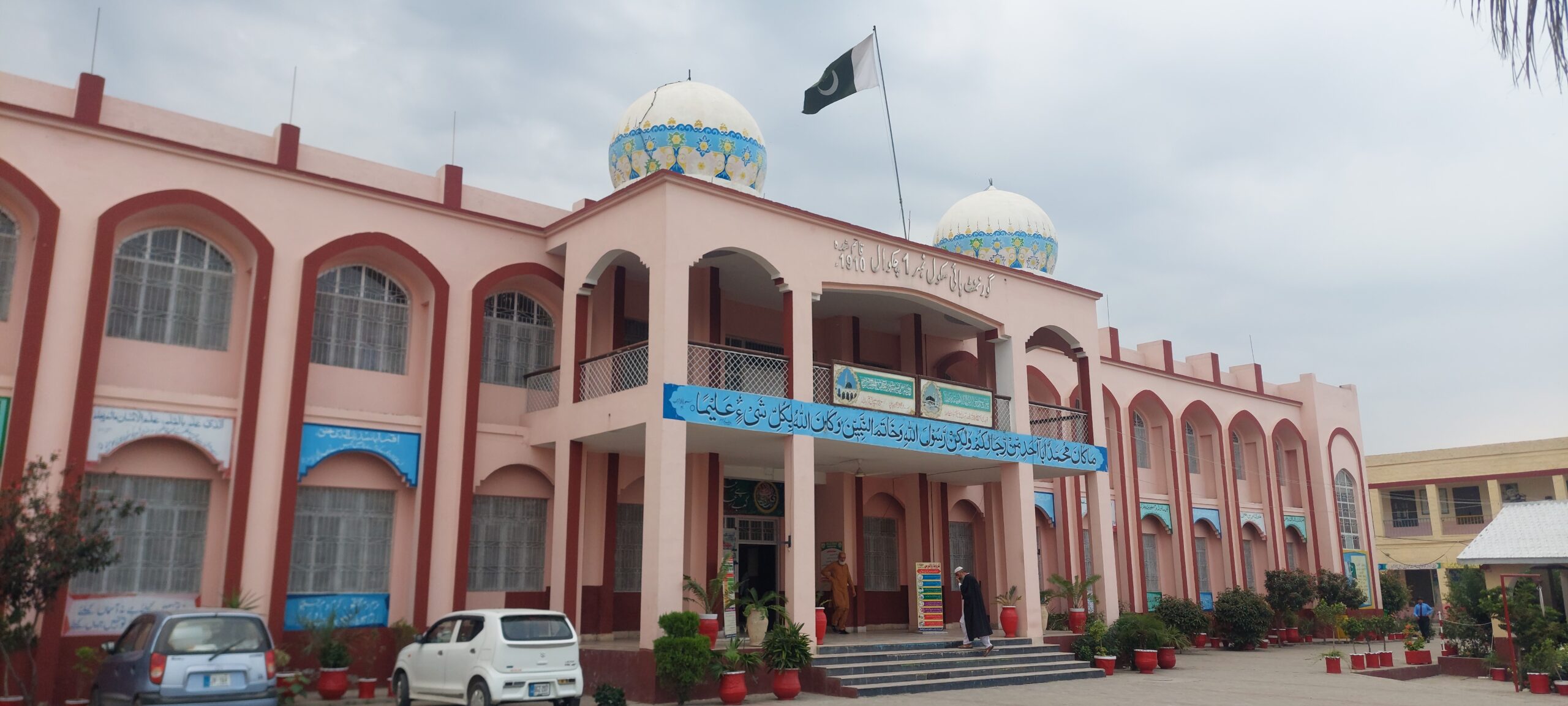
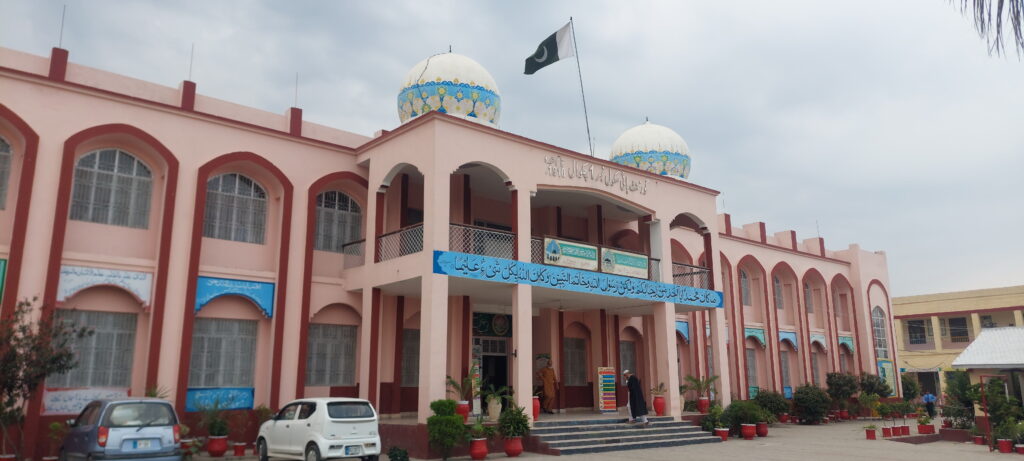
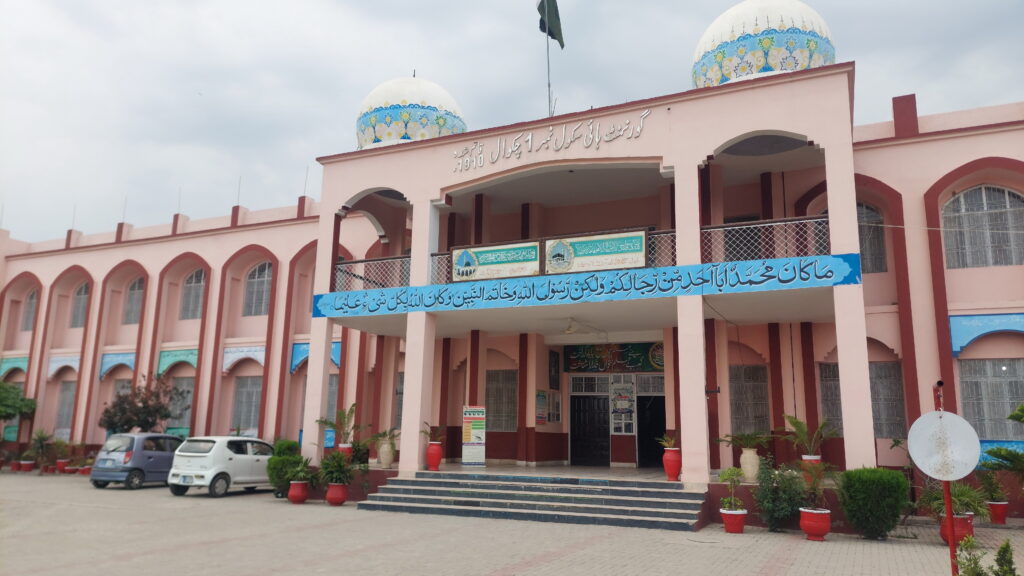
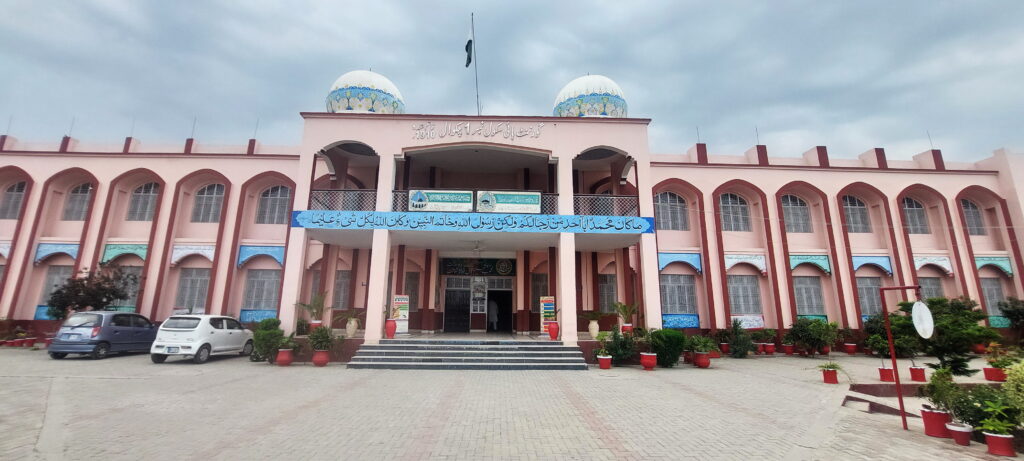
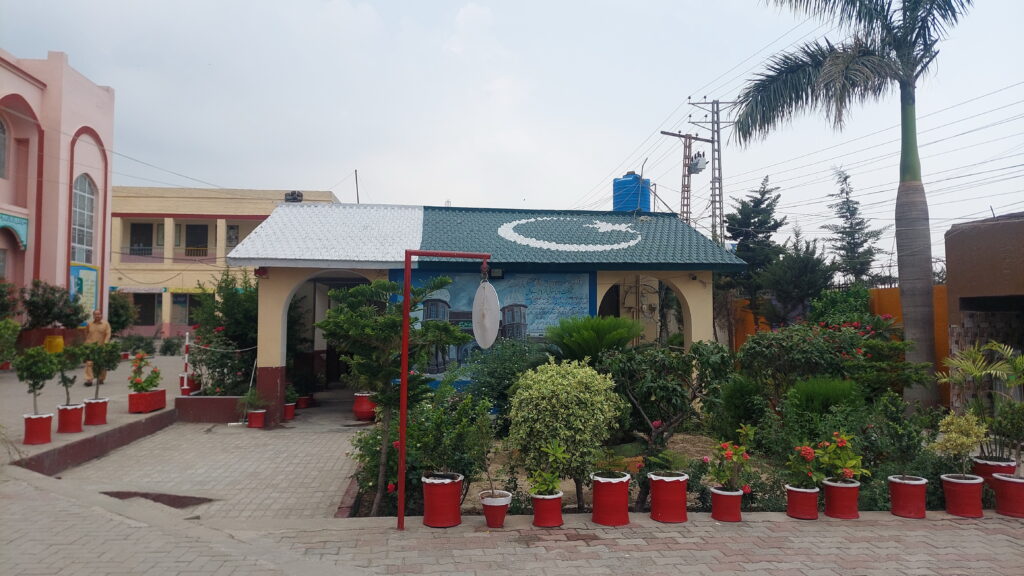
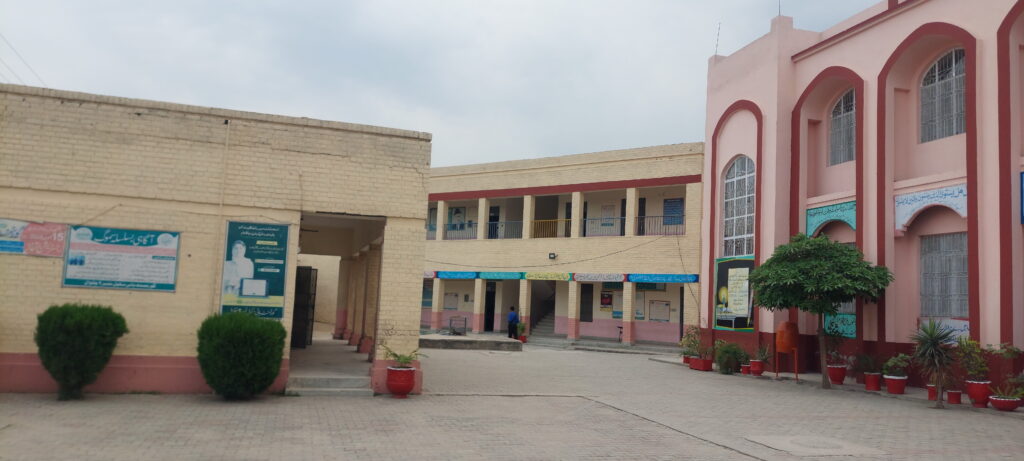
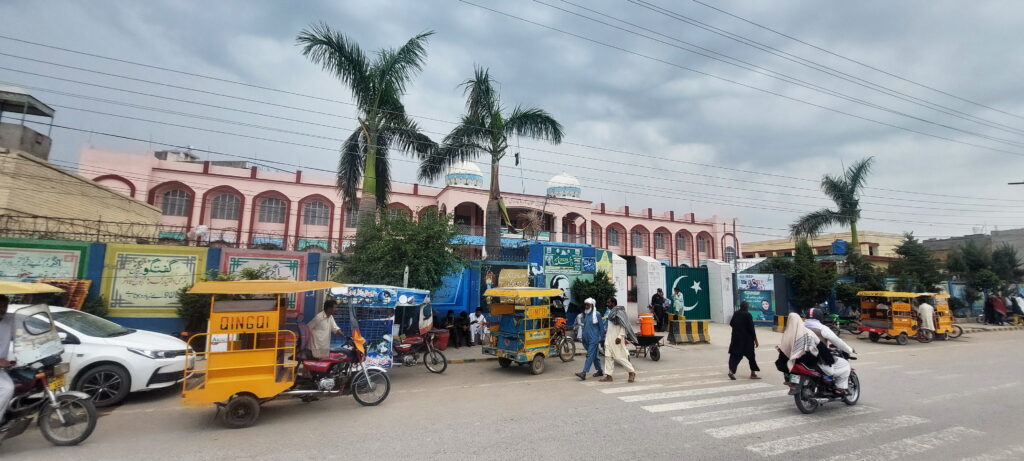
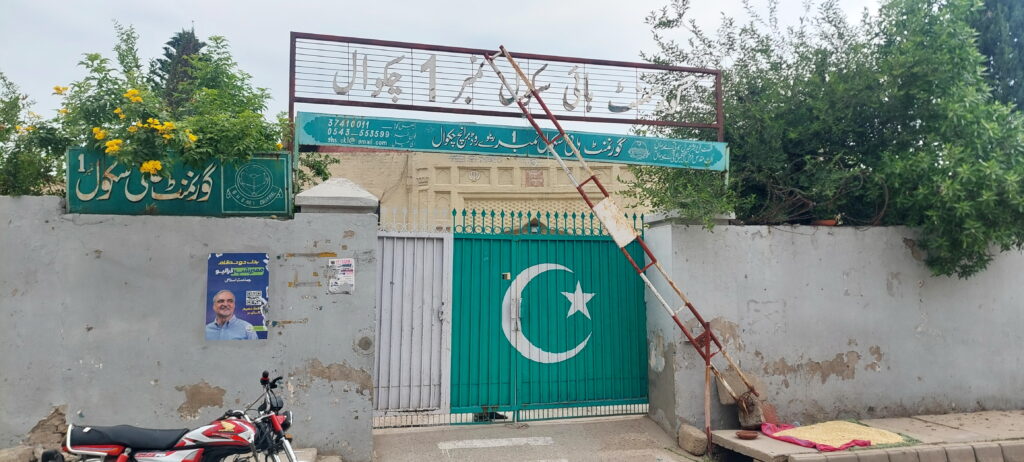
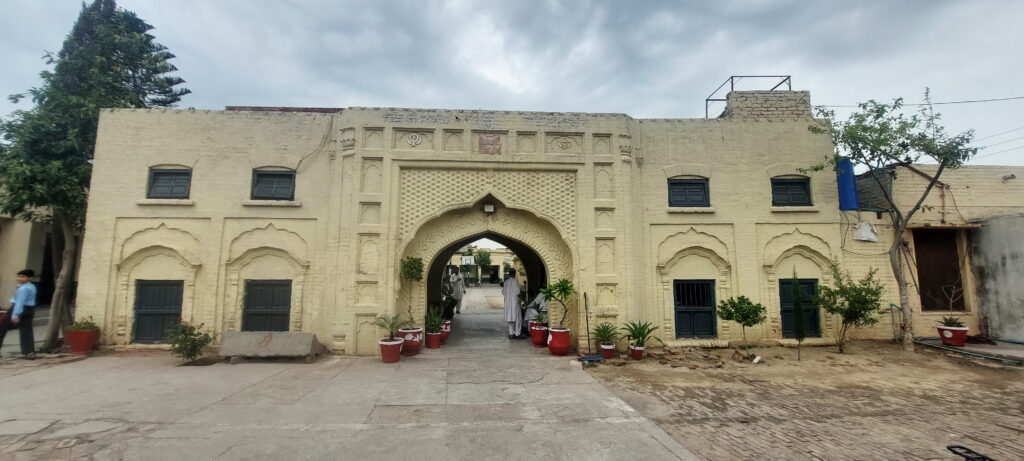
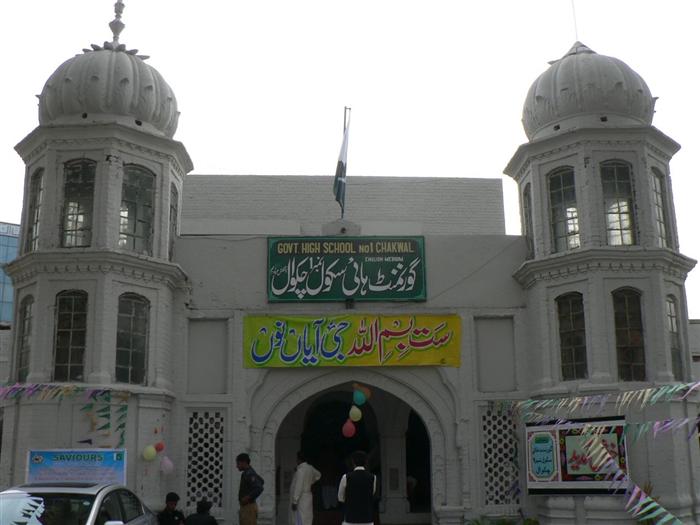
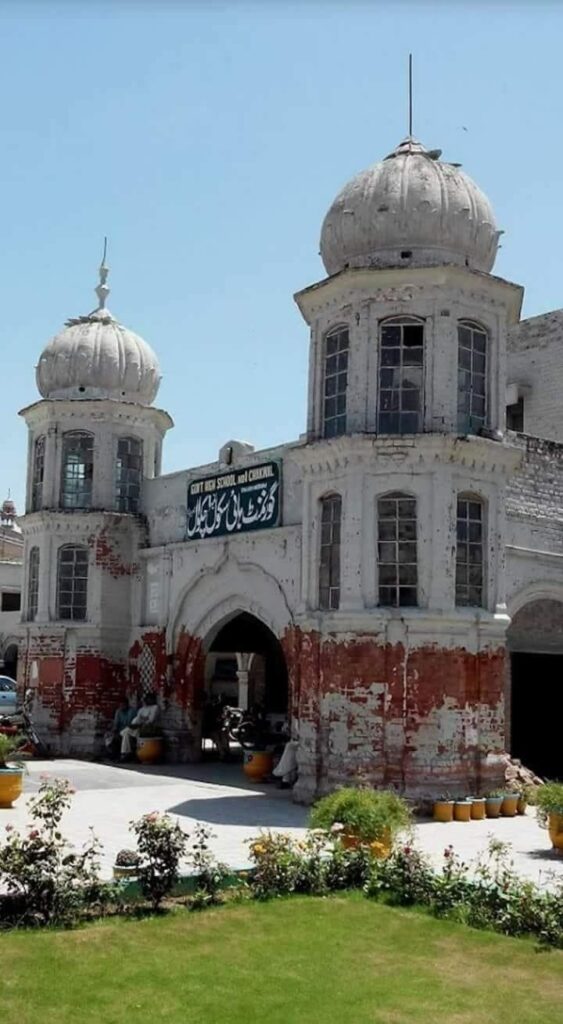
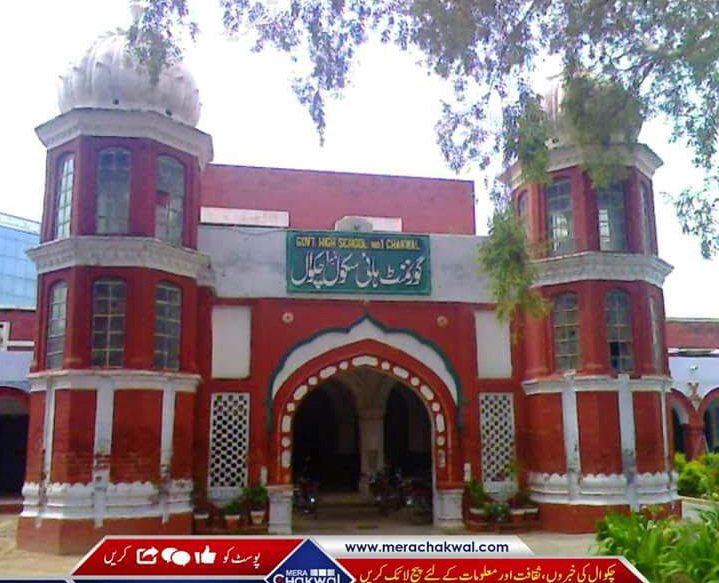
This historic school is located at 32°55’57.05″N, 72°51’21.50″E, in the heart of the city on the Chakwal–Talagang Road. Its magnificent building and beautiful façade impressed me. Though I was well aware that the original building had been torn down in 2016, I could not overcome my disappointment at the loss of this historic structure. This feeling was heightened when I noticed that no traces of the original building had survived. So much so that, in my confusion and disappointment, I did not enter the building, a decision which I now regret. Anyway, this feeling of disappointment lessened when I visited the hostel of the school later.
Munshi Sant Singh Khalsa School, Chakwal. (Govt. High School No. 1, Chakwal.)(14.05.2026.)The main entrance of the school. (14.05.2026.)The impressive facade of the building. (14.05.2026.)Looking towards the right side. (14.05.2026.)
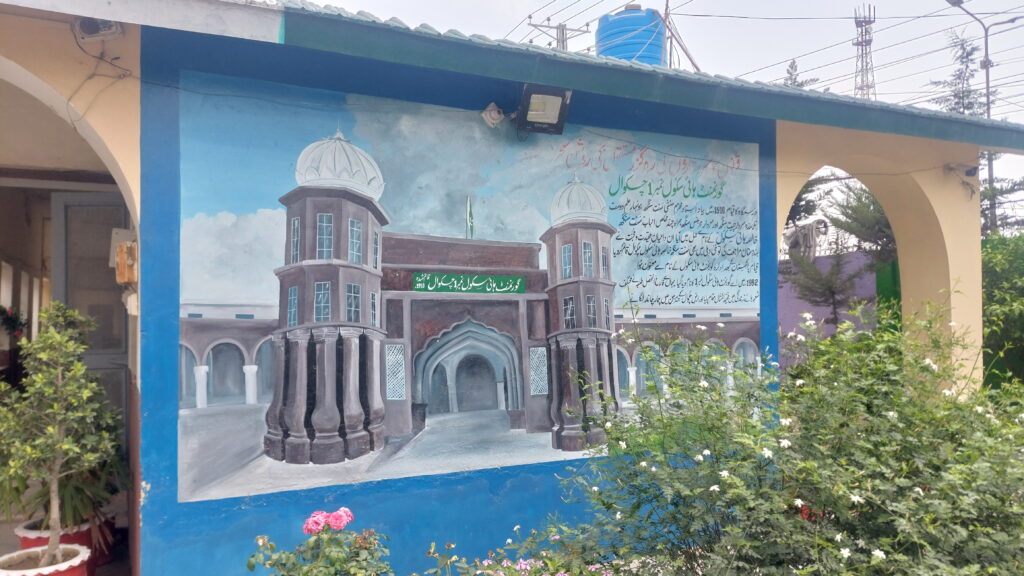
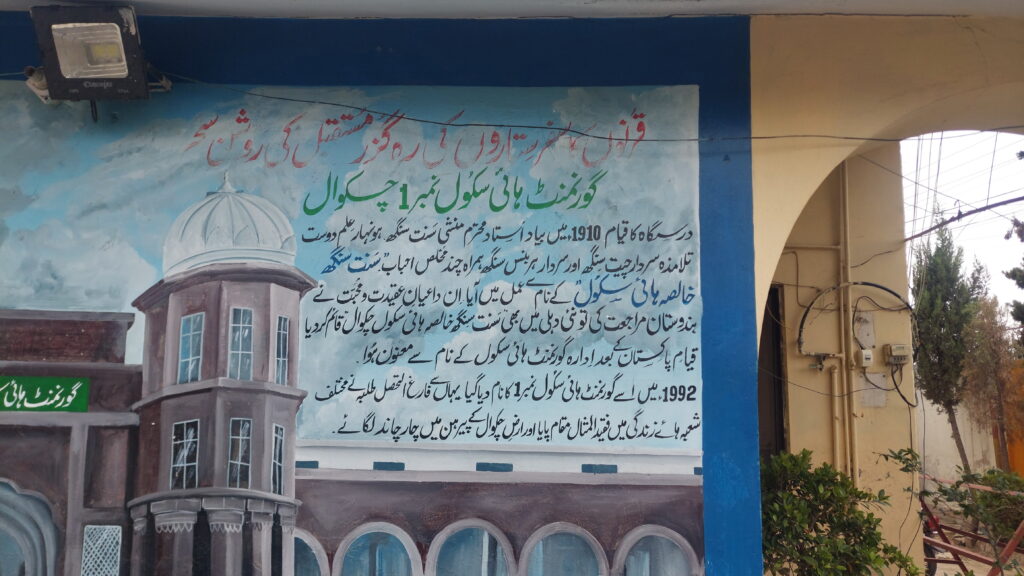
A painting of the old building of Munshi Sant Singh Khalsa School. (14.05.2026.)
استادِ محترم منشی سنت سنگھ کی یاد میں ان کے ہونہار اور علم دوست شاگردوں، سردار چیت سنگھ اور سردار ہربنس سنگھ، نے اپنے چند مخلص احباب کے ہمراہ 0191ء میں “سنت سنگھ خالصہ ہائی سکول” کی بنیاد رکھی۔
درس گاہ کا قیام 1910ء میں، استادِ محترم منشی سنت سنگھ کی یاد میں، ان کے ہونہار و علم دوست تلامذہ سردار چیت سنگھ اور سردار ہربنس سنگھ کے ہاتھوں چند مخلص احباب کے ہمراہ “سنت سنگھ خالصہ ہائی سکول” کے نام سے عمل میں آیا۔
ان داعیان عقیدت و محبت نے ہندوستان مراجعت کی تو نئی دہلی میں بھی “سنت سنگھ خالصہ ہائی سکول چکوال” قائم کردیا۔ قیامِ پاکستان کے بعد ادارہ گورنمنٹ ہائی سکول کے نام سے معنون* ہوا۔ 1992 میں اسے گورنمنٹ ہائی سکول نمبر 1 کا نام دیا گیا۔ یہاں سے فارغ التحصیل طلبہ نے مختلف شعبہ ہائے زندگی میں فقید المثال مقام پایا اور چکوال کے پیرہن میں چار چاند لگائے۔
I found the first sentence of the Urdu inscription confusing and lacking in clarity; hence, for clarity, I have changed the order of a few words and also made a small addition. In the third sentence, an Urdu word* has been used, which I have never seen used in this sense. However, it conveys the meaning to some extent.
दरसगाह का क़याम 1910 इ (ईस्वी) में, उस्ताद-ए-मुहतरम मुंशी संत सिंह की याद में, उनके हुनहार ओ इलम-दोस्त तलािमज़ा सरदार चेत सिंह और सरदार हरबंस सिंह के हाथों कुछ मुख़लिस अहबाब के साथ “संत सिंह ख़ालसा हाई स्कूल” के नाम से अमल में आया।
इन दाईयान-ए-अक़ीदत ओ मोहब्बत ने हिंदुस्तान मुराजअत की तो नई देहली में भी “संत सिंह ख़ालसा हाई स्कूल चकवाल” क़ायम कर दिया क़याम-ए-पाकिस्तान के बाद इदारा गवर्नमेंट हाई स्कूल के नाम से मानून* हुआ। 1992 में इसे गवर्नमेंट हाई स्कूल नंबर 1 का नाम दिया गया। यहाँ से फ़ारिगुत-तहसील तलबा ने मुख़्तलिफ़ शुबहा-ए-ज़िंदगी में फ़क़ीदुलमिसाल मुक़ाम पाया और चकवाल के पैरहन में चार चाँद लगाए।
Translation in English:
The institution was established in 1910 under the name “Sant Singh Khalsa High School” by the distinguished and knowledge-loving pupils of the revered teacher Munshi Sant Singh, namely Sardar Chet Singh and Sardar Harbans Singh, together with a number of devoted associates, in memory of their mentor.
When these devoted admirers and benefactors later migrated to India, they also founded “Sant Singh Khalsa High School Chakwal” in New Delhi. After the establishment of Pakistan, the institution was renamed Government High School. In 1992, it was given the name Government High School No. 1.
Graduates of this institution went on to achieve remarkable distinction in various walks of life and brought great honour and prestige to Chakwal.
Looking towards the left side. (14.05.2026.)A view from the main road. (14.05.2026.)
History of the School:
Plaques:
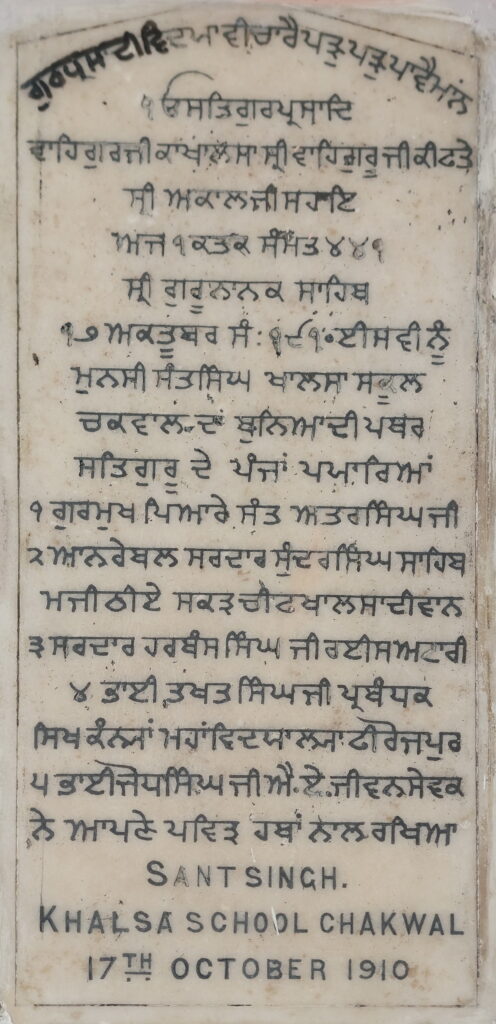
The old building has completely vanished without leaving any trace behind. Fortunately, however, someone was considerate enough not only to recognize the importance of the plaques affixed to the building but also to take steps to preserve them. As a result, these historic plaques can still be seen at the main entrance of the school. This single act of preservation has safeguarded valuable information and memories for generations to come.
گُرپرسادی وِدیا وِچارے پڑو پڑو پوے مان (گرو کے فضل سے انسان علم پر غور کرتا ہے، اور پڑھنے لکھنے سے عزت و احترام حاصل کرتا ہے۔) 1 اونکار ست گُرپرساد (ایک خدا، سچے گرو کے فضل سے حاصل ہوتا ہے۔) واہِ گُرو جی کا خالصہ سری واہِ گرو جی کی فتح سری اکال جی سہائے اج 9 کتک سمت 441 سری گرونانک صاحب 71 اکتوبر سن 0191 عیسوی نوں مُنشی سنت سنگھ خالصہ سکول چکوال دا بنیادی پتھر ست گرو دے پنج پیاریاں 1- گورمکھ پیارے سنت اتر سنگھ جی 2- آنریبل سردار سُندر سنگھ صاحب مجیٹھیئے سکتر چیف خالصہ دیوان 3- سردار ہربنس سنگھ جی رئیس اٹاری 4- بھائی تخت سنگھ جی پربندھک سکھ کنیاں مہاں وِدیالیا فیروزپور 5- بھائی جودھ سنگھ جی اے۔ جیون سیوک نے آپڑیں پوِتر ہتھاں نال رکھیا
“By the Guru’s grace, one reflects upon knowledge; by reading and studying, one earns honour.” “The One (God) is realized by the grace of the True Guru.”
Today, on 9 Katak, 441 Nanak Shahi, 12 October 1910 AD, the foundation stone of Munshi Sant Singh Khalsa School, Chakwal was laid by the five dears of Guru.
1. Beloved of the Guru, Sant Atar Singh ji 2. Honourable Sardar Sunder Singh Majithia, secretary of the Chief Khalsa Diwan 3. Sardar Harbans Singh ji Raees of Attari 4. Bhai Takhat Singh Ji, Manager Sikh Girls’ High School/College, Ferozepur 5. Bhai Jodh Singhi ji, a lifelong servant / dedicated worker
SANT SINGH KHALSA SCHOOL CHAKWAL 17TH OCTOBER 1910
Panj Piaray:
The concept of the Panj Piaray (Five Beloved Ones) occupies an important place in the Sikh religion. It originated in 1699, when Guru Gobind Singh called a large gathering of Sikhs at Anandpur Sahib on the occasion of Vaisakhi. There, he asked for volunteers who were willing to sacrifice their lives for their faith. Five men responded to his call and presented themselves before the Guru. These men belonged to different regions and social backgrounds, reflecting the Sikh belief in equality among all human beings.
Guru Gobind Singh initiated them into the Khalsa through the Amrit ceremony and gave them the title of Panj Piaray. According to Sikh tradition, he then requested the Panj Piaray to initiate him as well, thereby emphasizing the collective authority of the Khalsa.
Since then, the Panj Piaray have held a special place in Sikh religious life and continue to play an important role in major ceremonies and processions. Even today, when an important religious event is organized, such as the inauguration of a gurdwara, a religious procession, or the laying of a foundation stone for a Sikh institution, five initiated Sikhs are often chosen to represent the Panj Piaray. Dressed in the traditional Sikh manner, they lead the ceremony and symbolize the spirit of service, sacrifice, and collective leadership established by Guru Gobind Singh more than three centuries ago.
Since then, the Panj Piaray have held a special place in Sikh religious life and continue to play an important role in major ceremonies and processions. Even today, at important religious and community events, such as processions, inaugurations, and foundation-stone ceremonies, five initiated Sikhs are often chosen to represent the Panj Piaray. Their presence symbolizes the tradition established by Guru Gobind Singh in 1699.
1. Sant Atar Singh ji
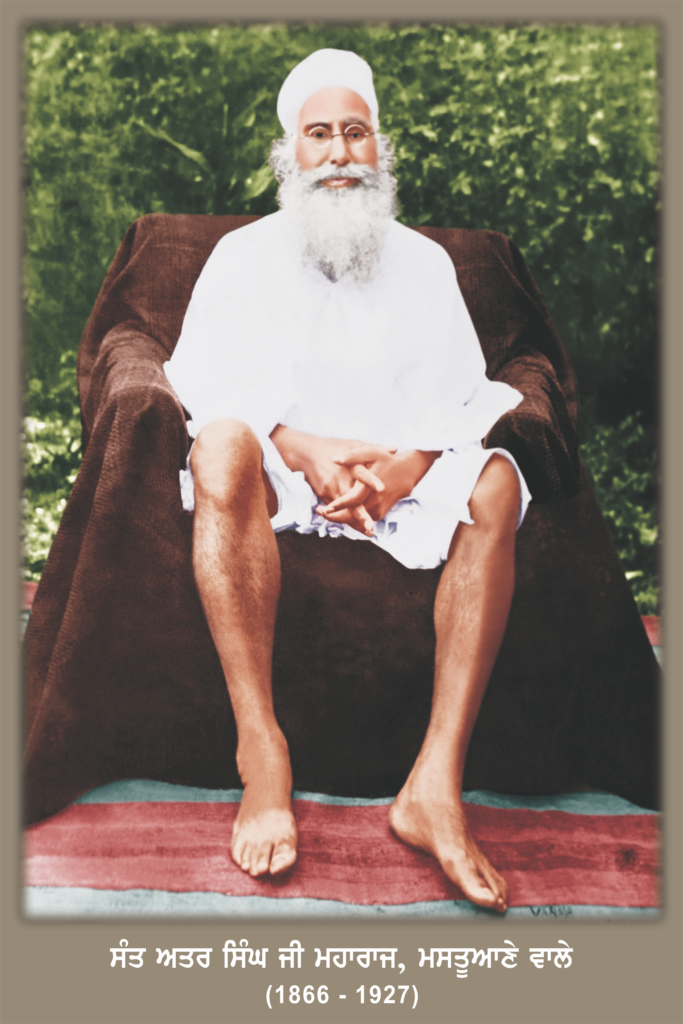
Sant Attar Singh Ji (1866–1927) of Mastuana Sahib is regarded as a key figure in the Sikh revival and reform movement of the late nineteenth and early twentieth centuries. He was born on 13 March 1866 in village Cheema, district Sangrur, in a modest farming family. Due to limited resources, he could not receive formal schooling in towns and was instead trained in religious learning under Nirmala teachers, where he studied Gurbani and Sikh philosophy. From early life, he showed a deep inclination towards naam simran and spiritual contemplation.
He later joined the British Indian Army, where he was initiated into the Khalsa and continued his scriptural studies. During this period, he became actively involved in the Singh Sabha reform ethos, focusing on restoring Sikh identity, promoting amrit sanchar, and encouraging disciplined religious practice. He travelled widely across Punjab and surrounding regions, delivering kirtan and inspiring large gatherings towards Gurmat values.
His most important contribution was the development of Gursagar Mastuana into a major centre of learning, kirtan, and seva. He also supported modern education and encouraged Sikhs to combine spiritual life with academic advancement. He passed away on 1 February 1927 at Sangrur, leaving a lasting legacy of devotion, reform, and institutional growth.
Atar Singh travelled widely and visited Peshawar, Kohat, and Rawalpindi on many occasions. He had a large following of devotees in the Potohar region as well. Fortunately, I have found a direct reference to him laying the foundation of a school in Chakwal in the book by Harbans Singh Doabia, Life Story of Sant Attar Singh Ji, in the following words:
“From Patiala Sant Ji came to Chakwal to lay the foundation of Chakwal School. After the foundation of the Chakwal School was laid by Sant Ji, he stayed there for some time. Religious Parchar (Sermons on the Sikh Religion) and the administration of KhandeDa-Amrit, as usual, were held on a very large scale. Then he came back to Mastuana Sahib.”
Sant Atar Singh ji Mahraj, of Mastuana. (1866 – 1927) Photo by Wikimedia Commons
2. Sardar Sundar Singh Majithia
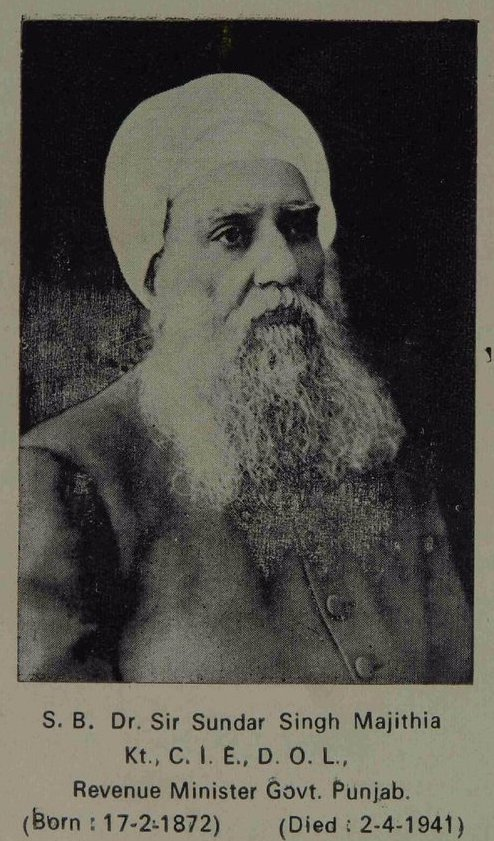
Sardar Sundar Singh Majithia was a prominent Sikh statesman, educationist, and reformer who played an important role in Sikh politics and society during the late nineteenth and early twentieth centuries. He was born in 1872 at Majitha, near Amritsar, and belonged to an aristocratic family. He received his education at Government High School, Amritsar, and Aitchison College, Lahore.
After completing his education, he became active in social and political activities. He was a founder member of Chief Khalsa Diwan and held its office of Secretary for a long time. He remained active for the promotion of education and was a member of the governing council of Khalsa College, Amritsar.
In 1921, he was elected to the Punjab Legislative Council and appointed as an executive councillor and revenue minister in the Punjab Government. In 1931, he led a Sikh deputation, which, met the Viceroy on 9 July 1931 and presented a charter of 17 demands on behalf of the Sikhs. He was elected to the Punjab Legislative Assembly from Batala constituency on 1 April 1937 and served in the Unionist Coalition government in the Punjab under the premiership of Sir Sikandar Hayat Khan as revenue minister, until his death in 1941.
He was given the title of Sardar Bahadur in 1911 and C.I.E., the Companion of the British Empire in 1920. He was knighted in 1926. He died in Lahore on 12 April, 1941.
A remarkable fact fact should be noted that the foundation stone of Khalsa School Chak no 29 SB, Sargodha district, was laid by Sardar Sujit Singh ji s/o Sardar Sundar Singh Ji in 1938. Sardar Sundar Singh ji too, visited this school on 24th March, 1940. For details visit the article.
Photo by Wikipedia.
3. Sardar Harbans Singh
The Attariwala family, is one of the most prominent Sikh aristocratic families of Punjab. Originally of Rajput origin, the family settled in the Punjab and rose to prominence under the Bhangi Misl and later under Maharaja Ranjit Singh. Over several generations, members of the family distinguished themselves in military service, administration, and public affairs.
Among the most notable figures were Sardar Nihal Singh, Sardar Sham Singh Attariwala, Sardar Chatar Singh, and Raja Sher Singh. The family played an important role in many of the military and political events of the Sikh Kingdom. Sham Singh Attariwala, in particular, earned lasting fame for his heroic death at the Battle of Sobraon in 1846. Chatar Singh and his son Sher Singh became leading figures in the events that culminated in the Second Anglo-Sikh War. Following the annexation of Punjab, several members of the family continued to enjoy social influence and held important positions under the British administration.
A later representative of the family was Sardar Ajit Singh of Attari, who served as Sub-Registrar, Assistant Commissioner, Honorary Magistrate, and President of the Amritsar District Board. He was regarded as one of the leading Sikh gentlemen of his time and received recognition from the British Government for his public service.
Sardar Harbans Singh, was the third son of Sardar Ajit Singh. He married a daughter of Rao Umrao Singh of Kuchai and possessed about 1,200 bighas of land, yielding an annual income of approximately Rs. 5,000. Although the account provides few further details about his life, it establishes him as a member of the distinguished Attari family and a landed gentleman of considerable means. I took this information from the Gazetteer of the District of Amritsar.
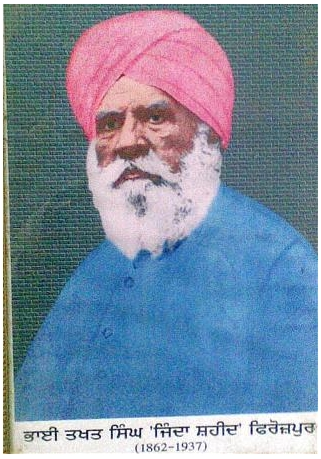
4. Bhai Takht Singh ji
Bhai Takhat Singh (1870–1937) was one of the pioneers of Sikh education and a leading advocate of women’s education in Punjab. Born in Ferozepur, he was influenced by the reformist ideas of the Singh Sabha movement, particularly those of Professor Gurmukh Singh and Giani Ditt Singh. At a time when female education was widely opposed, he dedicated his life to the cause of educating Sikh girls.
In 1892, he established the first Sikh girls’ school at Ferozepur, which later developed into the renowned Sikh Kanya Mahavidyalaya. The venture faced strong social resistance, and initially it was difficult to find even a handful of students. Through perseverance, persuasion, and the support of his wife, Bibi Harnam Kaur, he succeeded in overcoming these obstacles. The couple devoted their lives and resources to the institution, even selling personal belongings to sustain it.
As the school expanded, Bhai Takhat Singh undertook extensive fundraising tours, travelling as far as East Asia and China to collect funds for the construction of school buildings and hostels. His determination earned him the title of “Zinda Shaheed” (Living Martyr). Beyond education, he was active in religious and literary work, supporting Sikh scholars, establishing libraries, and promoting Sikh missionary activities. He remained devoted to these causes until his death on 18 December 1937, leaving behind a lasting legacy in the fields of education and social reform.
Bhai Jodh Singh (1882–1981) was one of the foremost Sikh scholars, educationists, and public figures of twentieth-century Punjab. After joining Khalsa College, Amritsar, as a lecturer in Sikh studies, he rose to become its Principal in 1936 and served the institution with great distinction. He played an important role in Sikh educational and religious affairs and was actively associated with the Singh Sabha movement and the Sikh Educational Conference.
A prolific writer, he authored numerous works on Sikh religion and philosophy in both Punjabi and English. He also contributed to major reference works and helped promote the study of Sikh history and literature. After Independence, he served on several educational and literary bodies, became the founding President of the Punjabi Sahit Akademi, and, at the age of eighty, was appointed the first Vice-Chancellor of Punjabi University, Patiala.
Known for his discipline, simplicity, devotion, and generosity, Bhai Jodh Singh remained intellectually active until the end of his long life. He passed away in 1981, leaving behind a rich legacy of scholarship and public service.
The last three persons mentioned above were closely associated with the Khalsa Diwan and worked together in promoting education and other social causes. Their association is described as follows on SikhNet:
“He (Bhai Takht Singh) was very active in organising and conducting the functions of Khalsa Diwan along with Bhai Jodh Singh and Sardar Harbans Singh Attari. He helped Sikh scholars like Bhai Kahn Singh, Sardar Karam Singh Histrorian, Bawa Prem Singh Hoti Mardan, S Sardul Singh Kaveeshar, Bhai Teja Singh Panch khand Bhasaur, S. Harbans Singh Majithia of Khalsa Diwan, Bhai Jodh Singh, Gyani Ditt Singh and Bhai Veer Singh, to quote a few, but also provided them guidance, financial assistance and books from his libraries.”
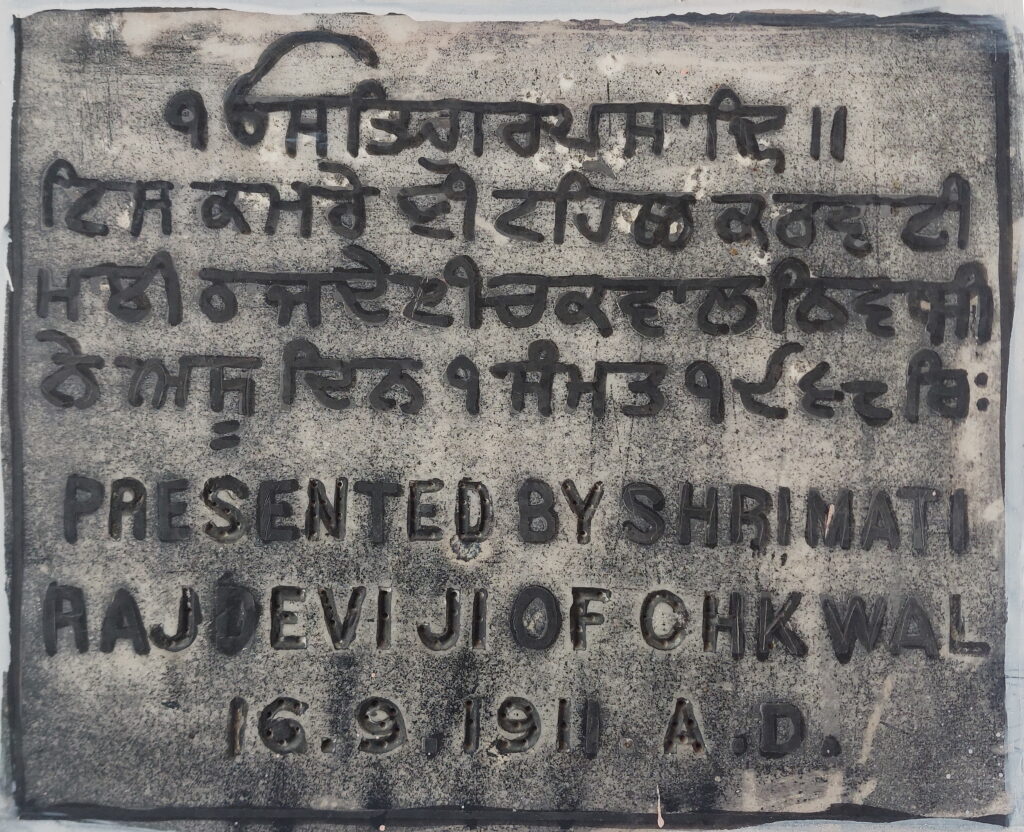
1 اونکار ست گُرپرساد “ایک خدا، سچے گرو کے فضل سے حاصل ہوتا ہے۔” اِس کمرے دی ٹہل کروائی مائی راج دیوی چکوال نِواسی نے اسو دن 1 سمت 1968 بی (بِکرمی)
“The One (God) is realized by the grace of the True Guru.” Service for this room was rendered by Mai Raj Devi, a resident of Chakwal, on Assu 1, 1968 Samvat
PRESENTED BY SHRIMATI RAJ DEVI OF CHKWAL 16.9.1911. A.D.
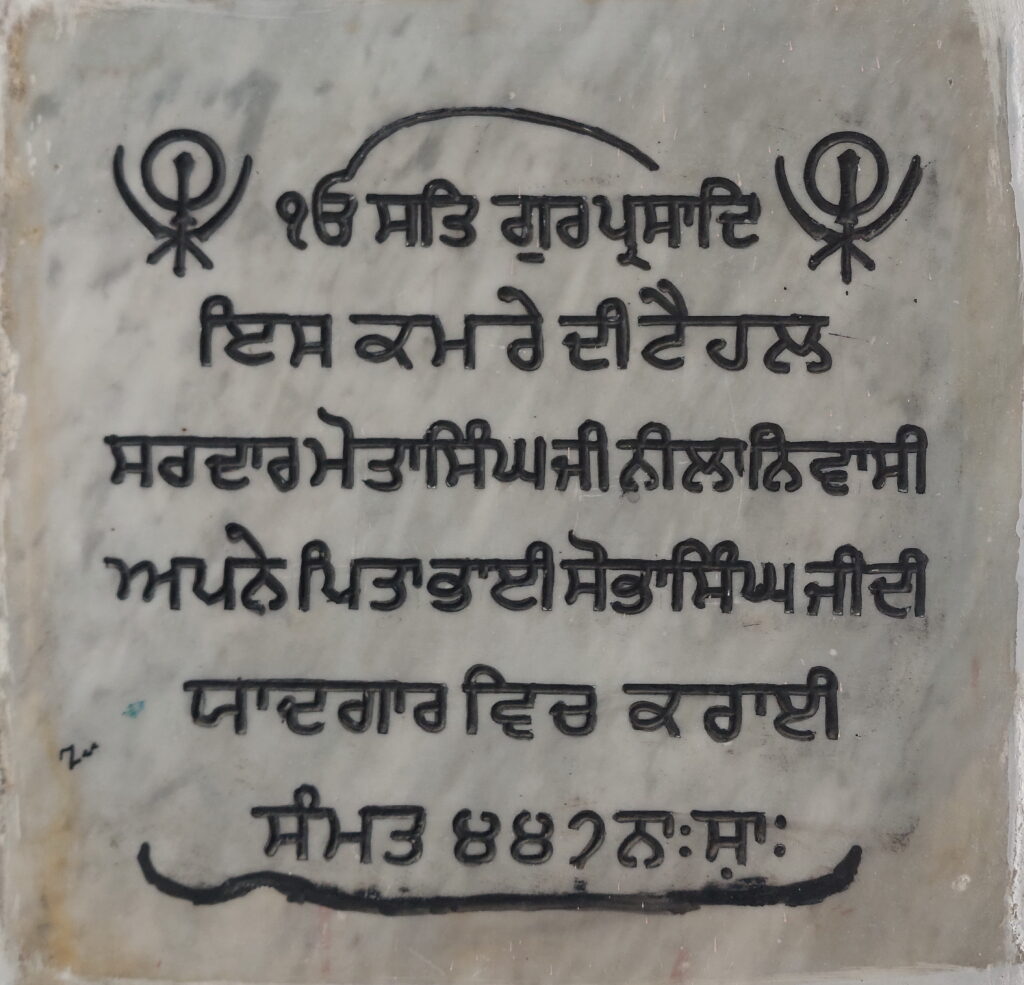
1 اونکار ست گُرپرساد “ایک خدا، سچے گرو کے فضل سے حاصل ہوتا ہے۔ اس کمرے دی ٹہل سردار موتا سنگھ جی نیلہ نِواسی اپنے پِتا بھائی سوبھا سنگھ جی دی یادگار وِچ کرائی سمت 447 نانک شاہی
“The One (God) is realized by the grace of the True Guru.” The service for this room was rendered by Sardar Mota Singh, a resident of Neela, in memory of his father Bhai Sobha Singh ji. Samvat 447 Nanak Shahi (1916 AD)
Sardar Mota Singh ji & His School at Neela:
Besides, making donation to this school. Sardar Mota Singh ji established another school at his native village Neela, named, Sardar Sahib Mota Singh School.
Sardar Mota Singh was born in 1885. He belonged to a humble family, and by the age of ten, both his parents had died. Some sources say that he did not receive any formal education. He was married into the family of Sardar Chet Singh, the founder of the Khalsa School at Munday. Mota Singh was the son-in-law of Sardar Jawala Singh, the elder brother of Sardar Chet Singh. This piece of information was shared with me by Sardar Ratan Deep Singh, the grandson of Sardar Chet Singh ji, from Delhi.
Sardar Chet Singh and his brother Jawala Singh were prominent and very successful businessmen in Iran. They were based in Zahedan and were involved in the construction of roads. They also worked as contractors for the British Army, running army canteens and providing other supplies. Sardar Mota Singh later joined them and, like them, made his fortune in business and trade. He established his business in several cities of Iran, as well as in Karachi, Lahore, and Gujar Khan. He traded in oil and dry fruits.
He used his vast resources for philanthropy and worked for the uplift of his native village, Neela. Despite being uneducated (or very little educated), he realized the importance of education and established a school in Neela. I was told by a senior teacher, Mr. Mahfooz, that this school cost him around Rs. 100,000, and that he bore the entire cost himself, without donations from other sources. He did not accept even free land and paid the price in full.
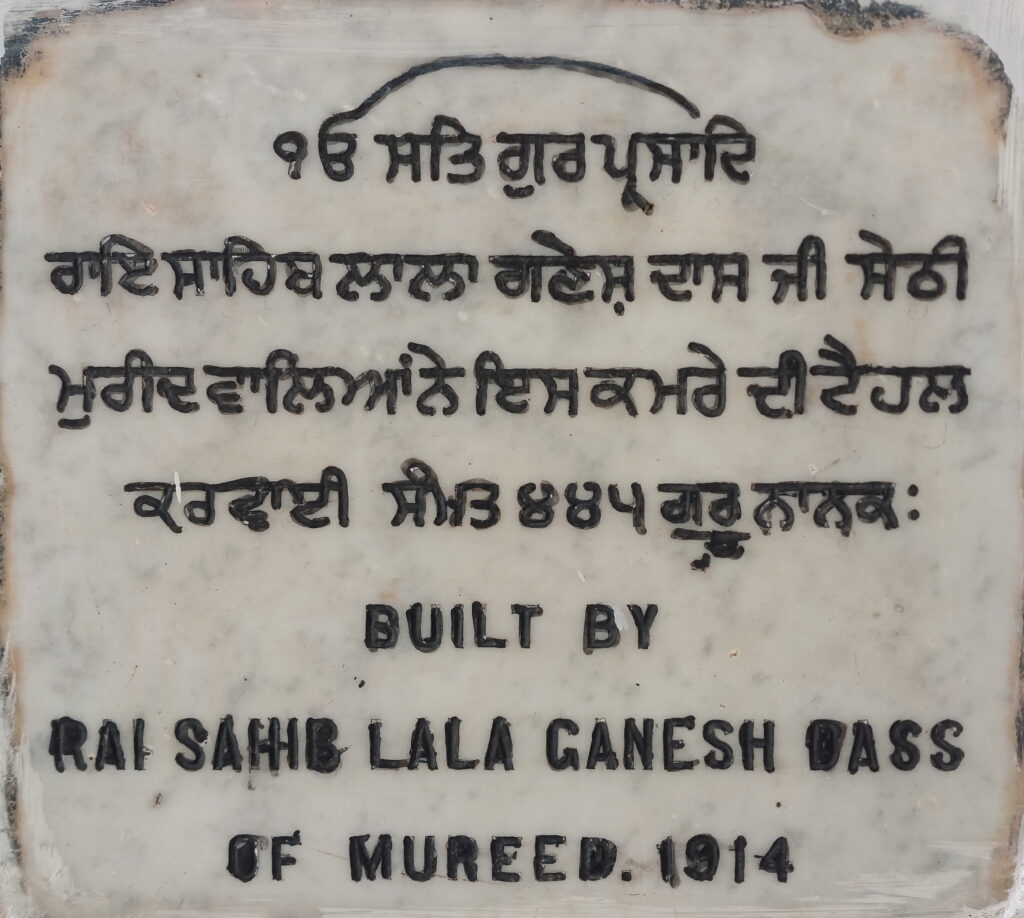
1 اونکار ست گُرپرساد “ایک خدا، سچے گرو کے فضل سے حاصل ہوتا ہے۔ رائے صاحب لالہ گنڑیش داس جی سیٹھی مرید والیاں نے اس کمرے دی ٹہل کروائی سمت 445 گرو نانک (1914 ء) “The One (God) is realized by the grace of the True Guru.” The service for this room was rendered by Rai Sahib Lala Ganesh Das ji Sethi, of Mureed. Samvat 445 Nanak Shahi (1914 AD)
BUILT BY RAI SAHIB LALA GANESH DASS OF MUREED. 1914
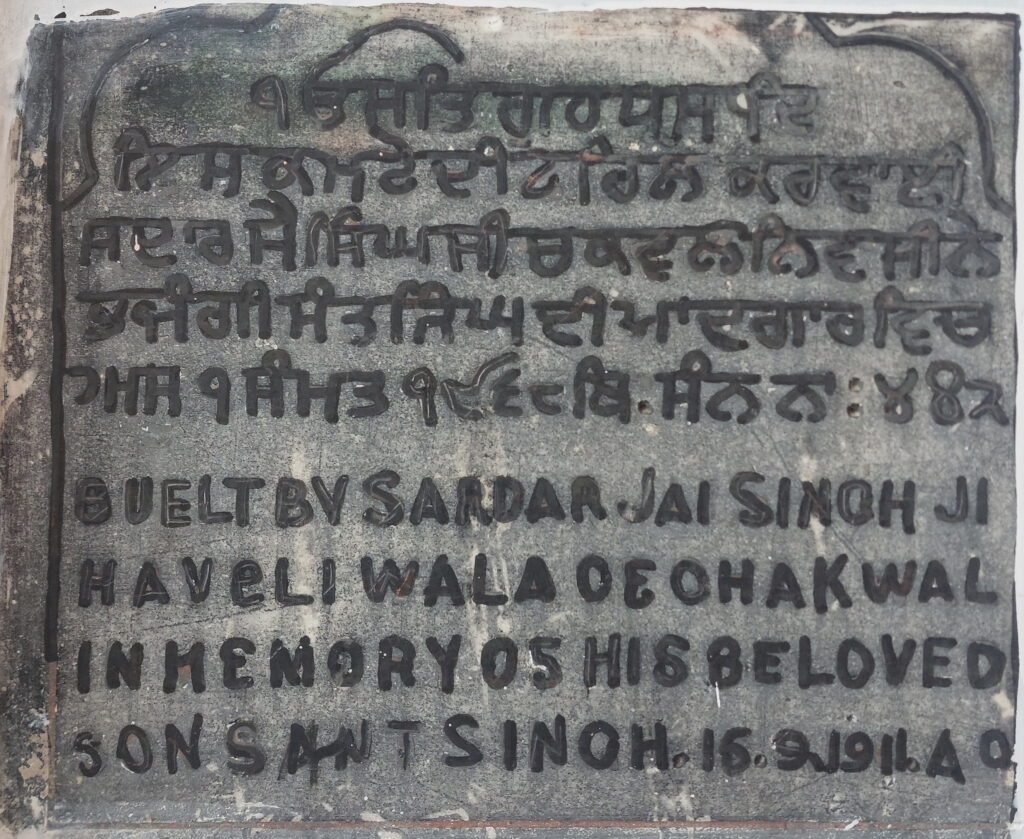
1 اونکار ست گُرپرساد “ایک خدا، سچے گرو کے فضل سے حاصل ہوتا ہے۔
اس کمرے دی ٹہل کروائی سردار جے سنگھ جی چکوال نواسی نے بھُجنگی سنت سنگھ دی یادگار وَچ اسو 1 سمت 1968 بِکرمی سن نانک شاہی 442
“The One (God) is realized by the grace of the True Guru.”
Service for this room was rendered by Sardar Jai Singh, a resident of Chakwal, in memory of his son Sant Sing. Assu 1 Samvat 1968 Bikramai. Year Nanak Shahi 442
BUILT BY SARDAR JAI SINGH JI HAVELI WALA OF CHAKWAL IN MEMORY OF HIS BELOVED SON SANT SINGH 16.9.1911. AD
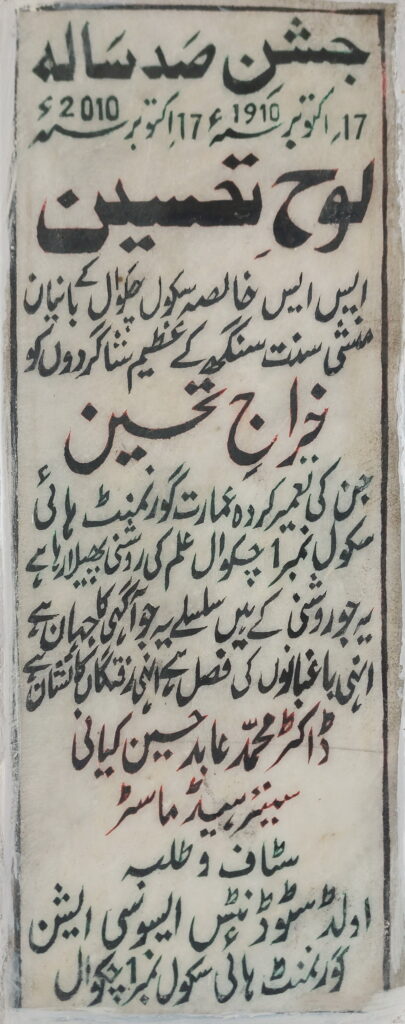
جشنِ صد سالہ 71 اکتوبر 0191ء 71 اکتوبر 0102ء لوحِ تحسین ایس ایس خالصہ سکول کے بانیان منشی سنت سنگھ کے عظیم شاگردوں کو
خراجِ تحسین
جن کی تعمیر کردہ عمارت گورنمنٹ ہائی سکول نمبر 1 چکوال علم کی روشنی پھیلا رہا ہے۔
یہ جو روشنی کے ہیں سلسلے یہ جو آگہی کا جہان ہے انہی باغبانوں کی فصل ہے، انہی رفتگاں کا نشان ہے
ڈاکٹر محمد عابد حسین کیانی سینیئر ہیڈ ماسٹر سٹاف و طلبہ اولڈ سٹوڈنٹس ایسو سی ایشن گورنمنٹ ہائی سکول نمبر 1 چکوال
जशन-ए-सद साला १७ अक्तूबर १९१० – १७ अक्तूबर २०१० लौह-ए-तेहसीन
एस. एस. ख़ालसा स्कूल चकवाल के बानिਯਾਨ मुंशी संत सिंह के अज़ीम शागिर्दों को।
खिराज-ए-तहसीन
जिनकी तामीर करदा इमारत गवर्नमेंट हाई स्कूल नंबर 1 चकवाल इल्म की रोशनी फैला रही है।
ये जो रोशनी के हैं सिलसिले, ये जो आगाही का जहान है उन्ही बाग़बानों की फ़सल है, उन्ही रफ़्तगाँ का निशान है।
डॉक्टर मुहम्मद आबिद हुसेन कियानी स्टाफ़ व तलबा ओल्ड स्टूडेंट्स एसोसिएशन गवर्नमेंट हाई स्कूल नंबर 1 चकवाल
Centenary Celebrations 17 October 1910 – 17 October 2010
Plaque of Appreciation
A Tribute to the Founders of S.S. Khalsa School The distinguished disciples of Munshi Sant Singh
Tribute
To those whose constructed building, now Government High School No. 1, Chakwal, continues to spread the light of knowledge.
These chains of light, this world of awareness, Are the harvest of those gardeners; they are the legacy of those who have passed on.
Dr. Muhammad Abid Hussain Kiani Senior Headmaster
Staff and Students Old Students Association Government High School No. 1, Chakwal
Hostel of the School
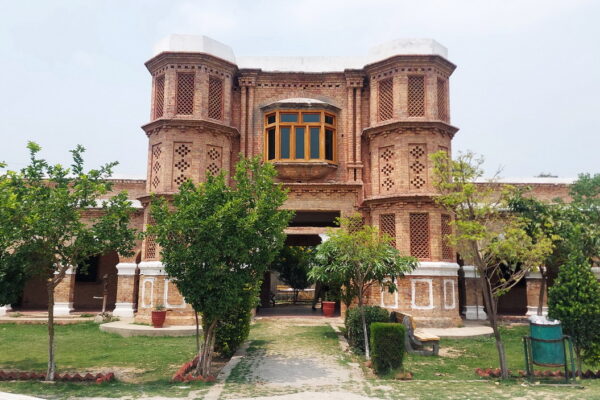
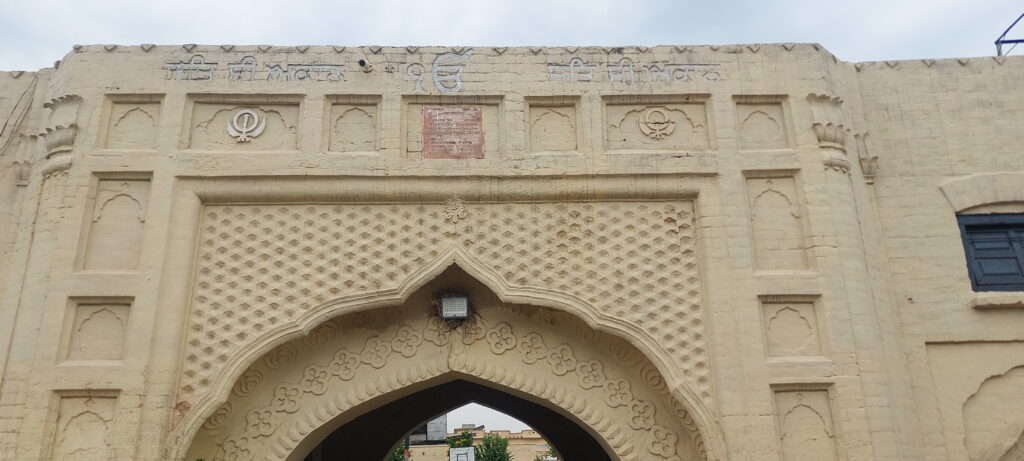
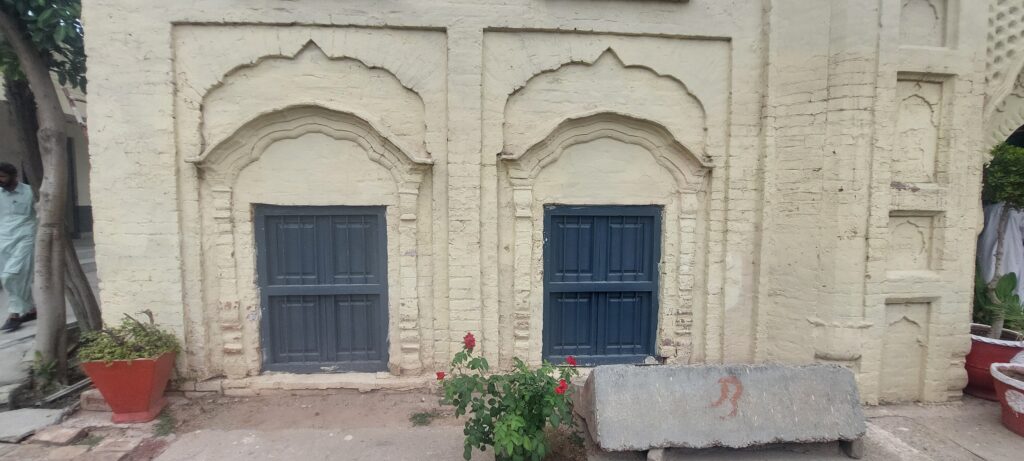
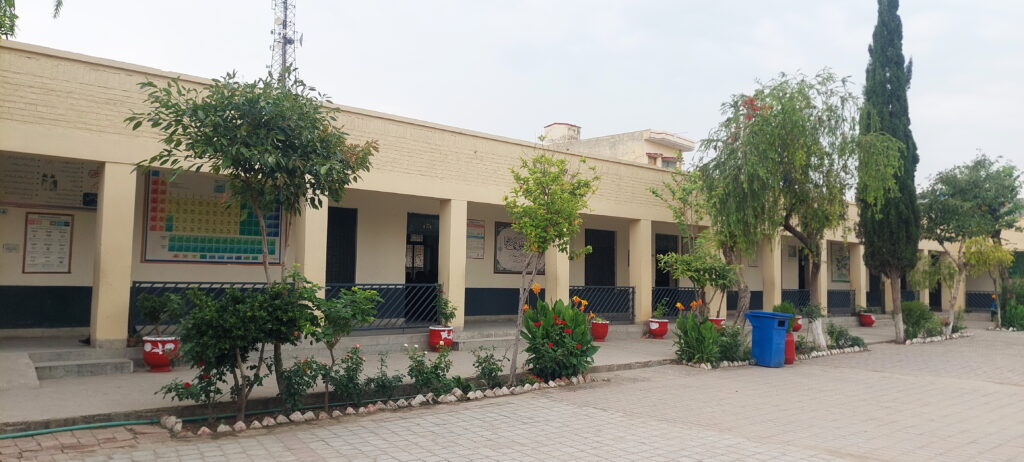
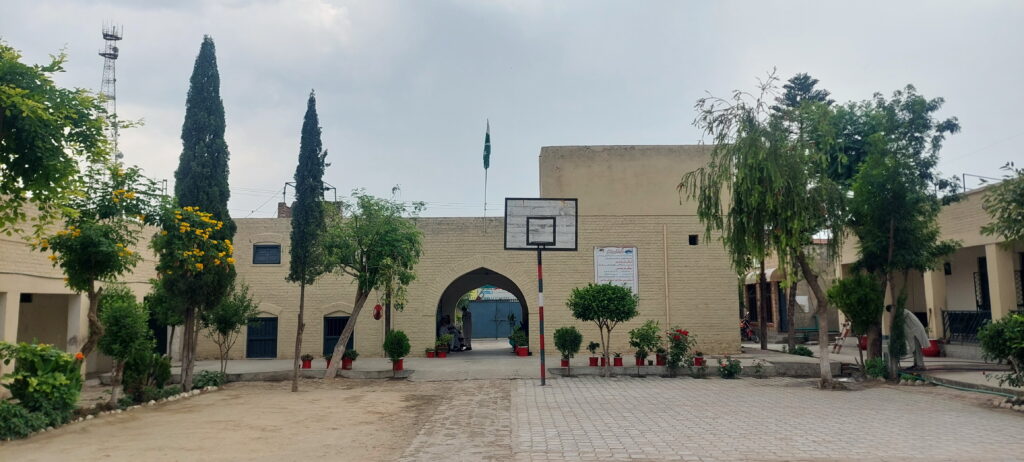
I almost missed the most interesting part of this tour. After visiting the school, I went in search of a dharamshala near the now-abandoned railway station of Chakwal. I could not find it; however, one enquiry after another led me to this building, of which I was only vaguely aware. This building was the hostel of the Munshi Sant Singh Khalsa School. It is now being used as the middle section of Government High School No. 1.
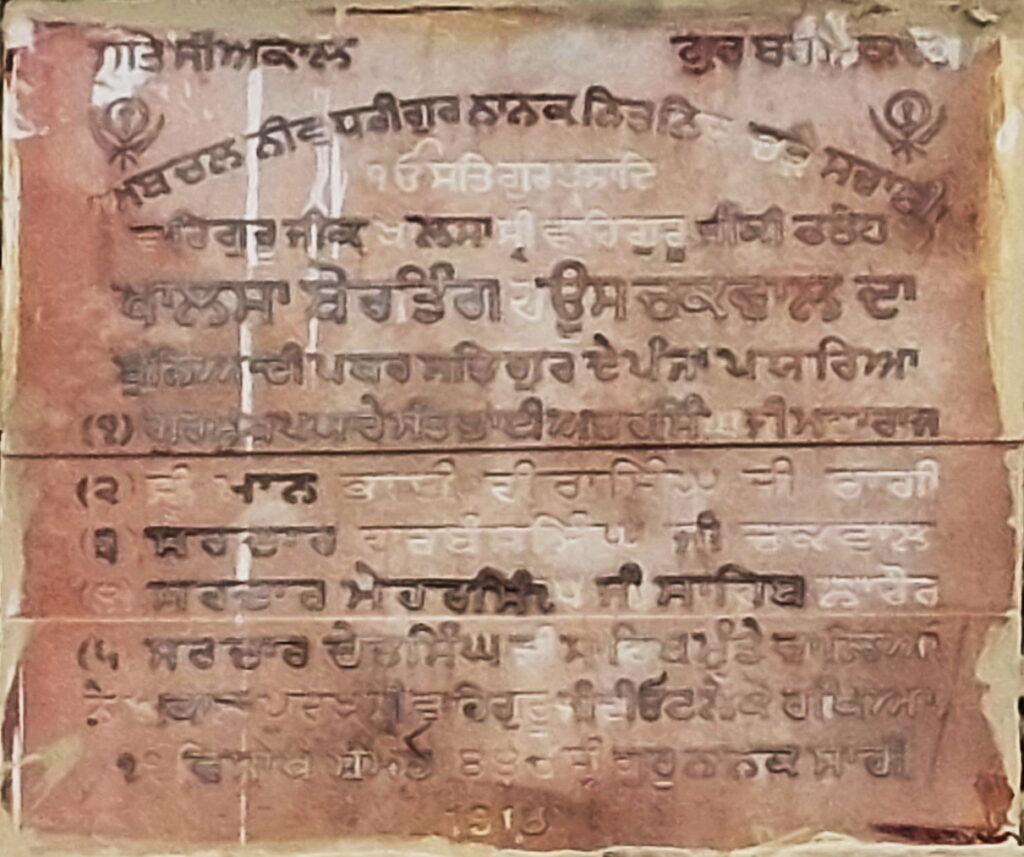
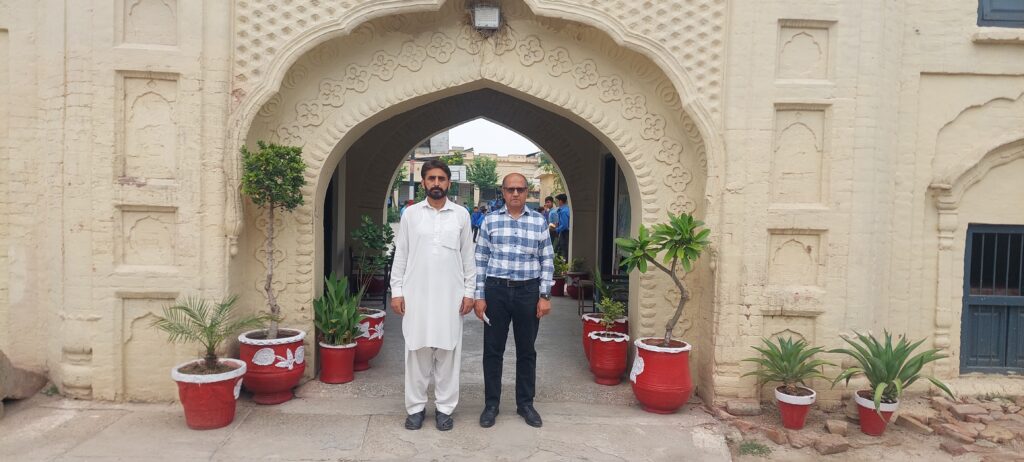
I was still just taking the picture of the main gate when I saw the plaque and the Khanda as well. Khanda is a sacred symbol in Sikhism consisting of a double-edged sword in the centre, a circular chakkar, and two single-edged swords. It represents truth, justice, and the balance between spiritual and worldly authority. The main attraction of this section is the old Deorhi building of the hostel. It is the only original structure that still exists of this school.
Main gate of the Govt. High School No. 1, the Middle Section. (14.05.2026.)The Deorhi of the hostel. (14.05.2026.)ਸਤਿ ਸ੍ਰੀ ਅਕਾਲ ੧ ਓ ਸਤਿ ਸ੍ਰੀ ਅਕਾਲ ست سری اکال 1 اونکار ست سری اکال God is the eternal truth. There is One God God is the eternal truth.
ਨੇ ਆਪਣੇ ਪੁਰਖਾਂ ਵਾਹਿ ਗੁਰੂ ਜੀ ਦੀ ਓਟ ਲੈਕੇ ਰਖਿਆ ੧- ਵਿਸਾਖ ਸਮਤ ੪੪੯ ਗੁਰੂ ਨਾਨਕ ਸ਼ਾਹੀ 1918 ست سری اکال گور بار اکال “ابدیت والی ذات خدا ہے۔ گرو ابدی خدا ہے”
ابچل نیو دھری گرو نانک نِت نِت چڑے سوائی “گرو نانک نے ایک اٹل اور مضبوط بنیاد رکھی، جو دن بہ دن مزید ترقی اور فروغ حاصل کر رہی ہے۔” 1 اونکار ست گُرپرساد “ایک خدا، سچے گرو کے فضل سے حاصل ہوتا ہے۔“
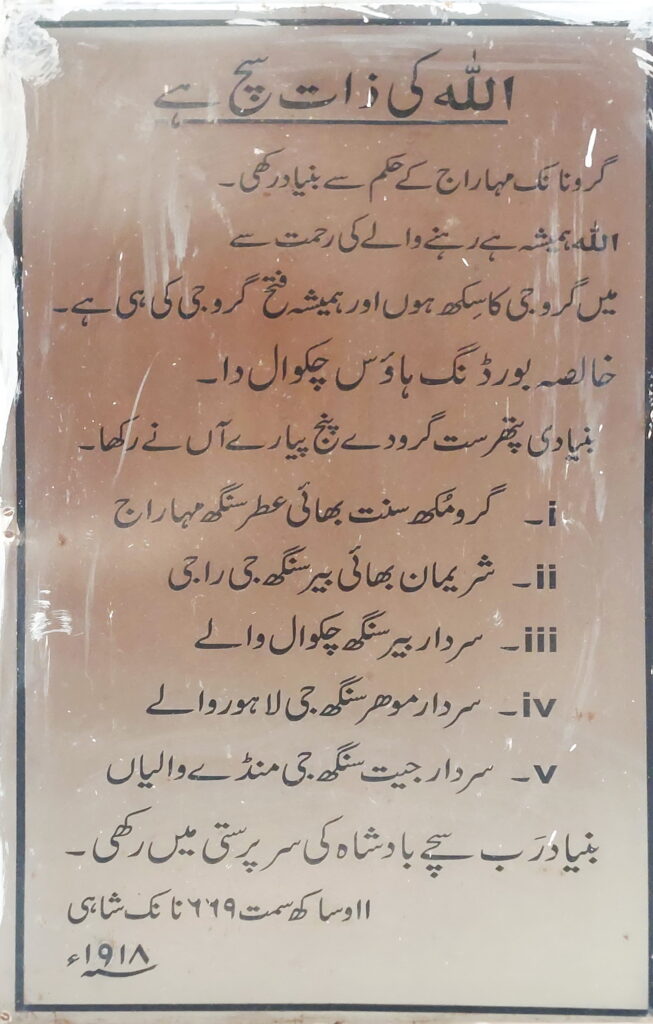
واہِ گرو جی کا خالصہ واہِ گرو جی کی فتح خالصہ بورڈنگ ہاؤس چکوال دا بنیادی پتھر ست گرو دے پنج پیاریاں
1- گورمُکھ پیارے سنت اتر سنگھ جی مہاراج 2- سری مان بھائی ہیرا سنگھ جی راگی 3- سردار ہربنس سنگھ جی چکوال 4- سردار مہر سنگھ جی صاحب لاہور 5- سردار چَیت سنگھ جی صاحب مُنڈے والیاں
نے آپڑیں پُرکھاں واہِ گرو جی دی اوٹ لے کے رکھیا 1 وِساکھ 944 نانک شاہی 1918
“True is the Eternal One. The Guru’s door (or court) is eternal.” “Guru Nanak laid an unshakable foundation; it continues to grow and prosper more and more with each passing day.” “The One (God) is realized by the grace of the True Guru.”
“The Khalsa belongs to Waheguru (God), and Victory belongs to Waheguru (God).”
The foundation stone of the Khalsa Boarding House was laid by the five dears of the Guru:
1 – Dear of the Guru Sant Atar Singh ji Maharaj 2 – Sriman Bhai Heera Singh ji Ragi 3 – Sardar Harbans Singh ji Chakwal 4 – Sardar Mehr Singh ji Sahib Lahore 5 – Sardar Chet Singh ji Sahib of Munde
under the protection of their ancestors and Waheguru. 1 Visakh 449 Nanak Shahi 1918
Panj Piaray
1. Sant Atar Singh ji
Sant Atar Singh Ji laid the foundation stone of the school’s main building in 1911. It is noteworthy that he visited this institution again and also participated in the foundation stone–laying ceremony of the boarding house. A brief account of his life and contributions has been provided above.
2. Sardar Heera Singh ji Ragi
Could not find any information about him.
3. Sardar Harbans Singh ji
Sardar Harbans Singh Sistani was a prominent businessman of this area and was active in trade with Iran. Probably, he was based in the Sistan region of Iran, hence the sobriquet of Sistani. He, too, was involved in the establishment of this school, along with his friend Sardar Chet Singh of Munde. Unfortunately, I could not find more information about him.
4. Sardar Mehar Singh ji
Sardar Sahib Sardar Mehar Singh Chadha was a native of Saidpur village in Tehsil Chakwal. As a young man, he visited Sri Harmandir Sahib before departing for Iran in search of better economic opportunities. A deeply moving experience during this visit strengthened his faith and inspired him to dedicate a part of his future earnings to the service of the shrine.
Through hard work, honesty, and business acumen, Mehar Singh attained considerable success in Iran and became a respected member of the Indian community there. Despite his wealth and public recognition, including the title of “Sardar Sahib,” he remained devoted to Sri Harmandir Sahib and contributed generously towards its upkeep and development. Among his notable services were the installation of brass railings, donation of marble pillars, the reconstruction of Gurdwara Dukh Bhanjani Sahib, the establishment of annual Akhand Paths, and the provision of numerous furnishings and religious articles for the shrine.
The article also highlights his humility, as he generally avoided public recognition and preferred that his services remain anonymous. Following his death in 1973, his contributions were widely acknowledged, and his portrait was placed in the Central Sikh Museum. The article further records how subsequent generations of the Chadha family have continued this tradition of sewa, supporting various projects at Sri Harmandir Sahib and preserving the family’s long-standing association with the shrine.ion of selfless service, supporting numerous projects at Sri Harmandir Sahib and preserving his enduring legacy of faith, humility, and generosity.
Note: I am not sure whether this Sardar Mehar Singh ji, is the same person mentioned on the plaque. But there is a strong probability of being so.
5. Sardar Chet Singh ji
Sardar Chet Singh Kohli was a resident of Munde (or Munday), a village about 20 kilometers northwest of Chakwal city. He was a successful businessman and a generous philanthropist. Like many other Sikhs of this area, he had business interests in Iran. He was a wealthy man and used his resources for the benefit of the general public. He was a driving force behind the establishment of this school and, as we have seen from a plaque, was also actively involved in the establishment of a hostel for its students.
It is noteworthy that after establishing this school in Chakwal, he also founded a boys’ school, Hira Singh Khalsa School, in his native village of Munde. He built this school in the loving memory of his late father, Sardar Hira Singh. This school also flourished into a major educational institution and is still spreading the light of knowledge in the area. Besides this school, he also established Sardar Jawala Singh Mahan Singh Hospital in the village in memory of his elder brothers.
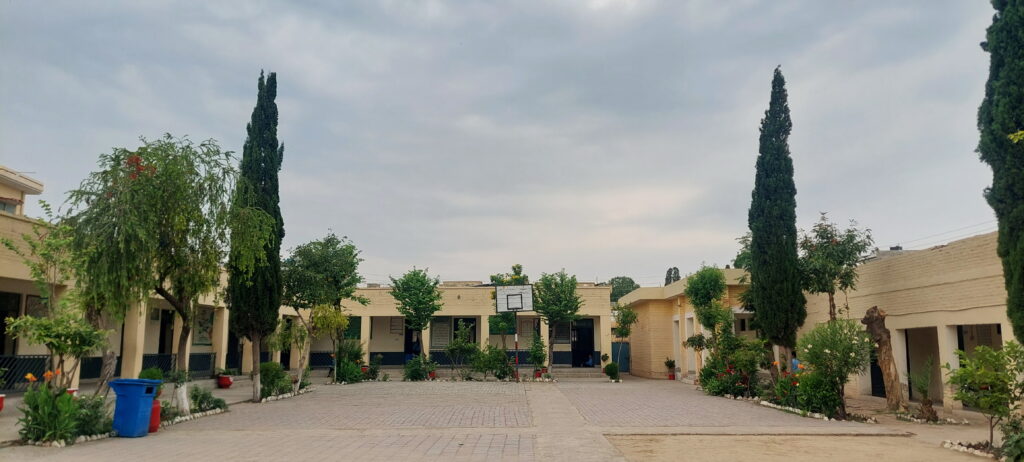
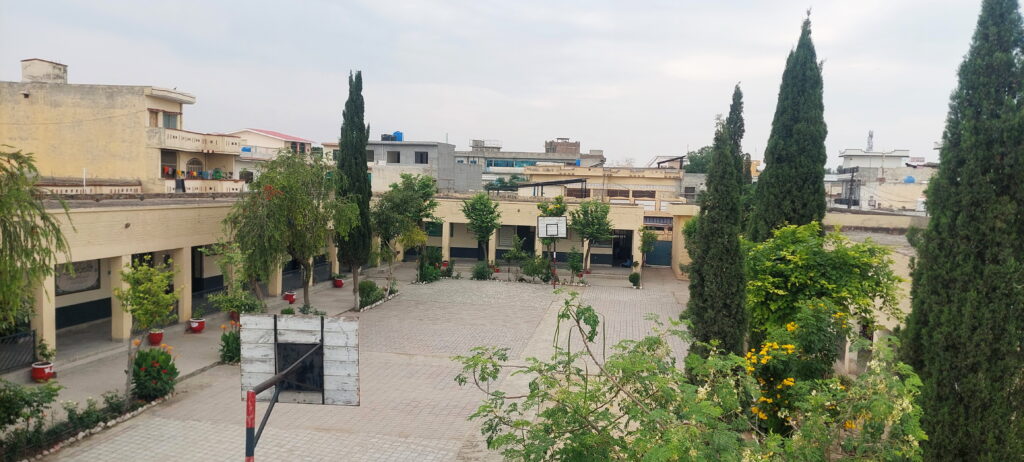
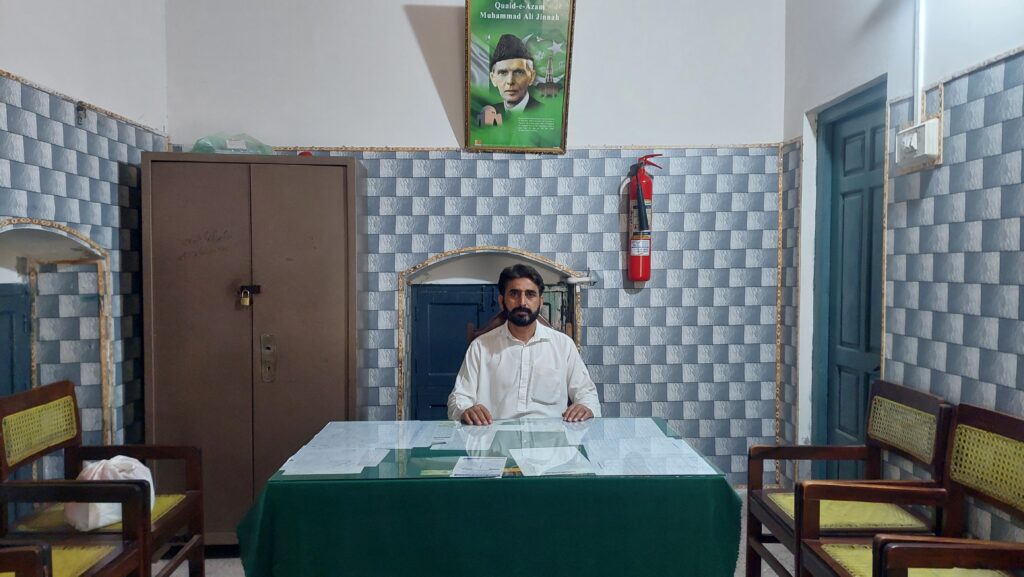
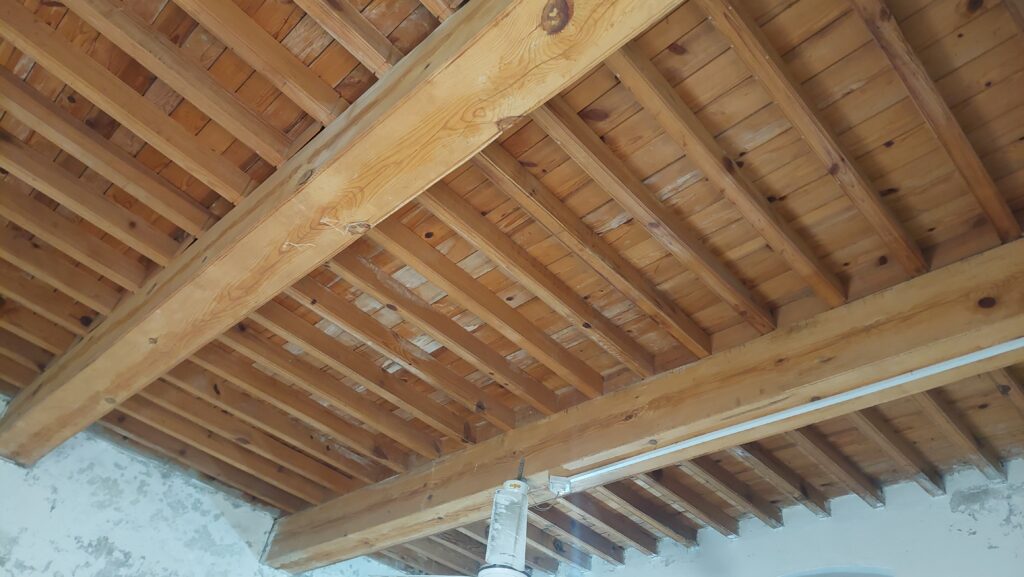
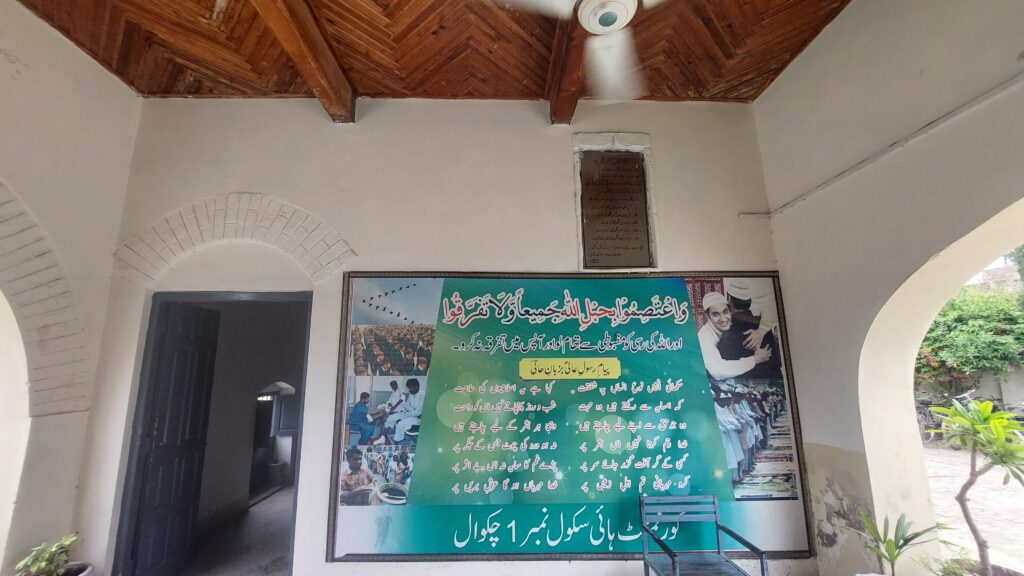
A closer look at the structure of Deorhi. (14.05.2026.)Once a hostel for the students of Khlasa School, now the middle section of the Govt. School. (14.05.2026.) A rown of classroom on the left . (14.05.2026.)A view of the Deorhi from inside. (14.05.2026.) An aerial view of the middle section. (14.05.2026.)Mr Naveed Ahmad Ahqar, the in-charge of the Middle Section of the Govt. High School Chakwal. (4.05.2026.) Mr Naveed Ahmad Ahqar with the writer. (14.05.2026.) Woodwork shows the quality of the construction. (14.05.2026.) Inside the Deorhi. (14.05.2026.)
اللہ کی ذات سچ ہے۔ گرو نانک مہاراج کے حکم سے بنیاد رکھی۔ اللہ ہے ہمیشہ رہنے والے کی رحمت سے میں گرو جی کا سکھ ہوں اور ہمیشہ فتح گرو جی کی ہی ہے۔ خالصہ بورڈنگ ہاؤس چکوال دا بنیادی پتھر ست گرو دے پنج پیاریاں نے رکھیا۔ i. گر مُکھ سنگھ بھائی عطر(اتر) سنگھ مہاراج ii. شریمان بھائی بیر* سنگھ جی راجی* iii.سردار بیر* سنگھ جی چکوال والے vi. سردار موھر* سنگھ جی لاہور والے v. سردار چیت سنگھ جی مُنڈے آلیاں
بنیاد رب سچے بادشاہ کی سرپرستی میں رکھی 11 وساکھ سمت *966 نانک شاہی
اس کتبے پر لکھی اردو تحریر میں کچھ غلطیاں ہیں جو نیچے درست کردی ہیں۔
شریمان بھائی ہیرا سنگھ جی راگی ii. سردار ہربنس سنگھ جی چکوال والے iii. سردار مہر سنگھ جی لاہوروالے iv.
उर्दू शिलालेख में मैंने कुछ गलतियाँ देखीं हैं, जिन्हें मैंने सुधार दिया है और हाइलाइट किया है।
अल्लाह की ज़ात सच है। गुरु नानक महाराज के हुक्म से बुनियाद रखी। अल्लाह है, सदा रहने वाले की रहमत से। मैं गुरु जी का सिख हूँ और हमेशा फ़तह गुरु जी की ही है। ख़ालसा बोर्डिंग हाउस चकवाल दा। बुनियादी पत्थर सतगुर दे पंज पियारिआं ने रखिया।
i. गुरमुख सिंह भाई अतर सिंह महाराज ii. श्रीमान भाई बीर सिंह जी राजी (श्रीमान भाई हीरा सिंह जी रागी) iii. सरदार बीर सिंह जी चकवाल वाले (सरदार हरबंस सिंह जी चकवाल वाले) iv. सरदार मोहर सिंह जी लाहौर वाले (सरदार मैहर सिंह लाहौर वाले) v. सरदार चीत सिंह जी मुंडे आलियाँ
बुनियाद रब सच्चे बादशाह की सरपरस्ती में रखी 11 वैशाख संवत ६६९ नानक शाही (४४९ नानक शाही)
English Translation:
In the Urdu inscription, I noticed some mistakes which I have corrected and highlighted.
God’s Being is True. The foundation was laid by the command of Guru Nanak Maharaj. By the grace of the Eternal One, I am a Sikh of the Guru, and victory forever belongs to the Guru. Khalsa Boarding House, Chakwal. The foundation stone was laid by the Five Beloved Ones (Panj Piare) of the True Guru.
1 – Dear of the Guru Sant Atar Singh ji Maharaj 2 – Sriman Bhai Beer Singh ji Raji (Sriman Bhai Heera Singh hi Ragi) 3 – Sardar Beer Singh ji of Chakwal (Sardar Harbans Singh ji of Chakwal) 4 – Sardar Mohr Singh ji Sahib Lahore (Sardar Mehr Singh ji Sahib Lahore) 5 – Sardar Chet Singh ji Sahib of Munde
The foundation was laid under the patronage of the True Sovereign Lord. 11 Vaisakh, 669 Nanakshahi (449 Nanak Shahi)
Naveed Ahmad Ahqar:
Naveed Sahib, as mentioned above, is in charge of the middle section of this school, which houses classes from Grade 6 to Grade 8. He also studied in this building as a student before completing his matriculation from the main branch of Government High School No. 1. He earned an M.A. in Urdu and later obtained an M.Ed. degree.
He began his career in education in 1995 and joined this school in 2008. Since 2021, he has been serving as the Vice Principal of the Elementary Section. I am grateful to him for giving me a tour of the school and the adjoining building, as well as for his warm hospitality. Although he was very busy, he graciously spared some of his valuable time for me, while attending to his numerous responsibilities.
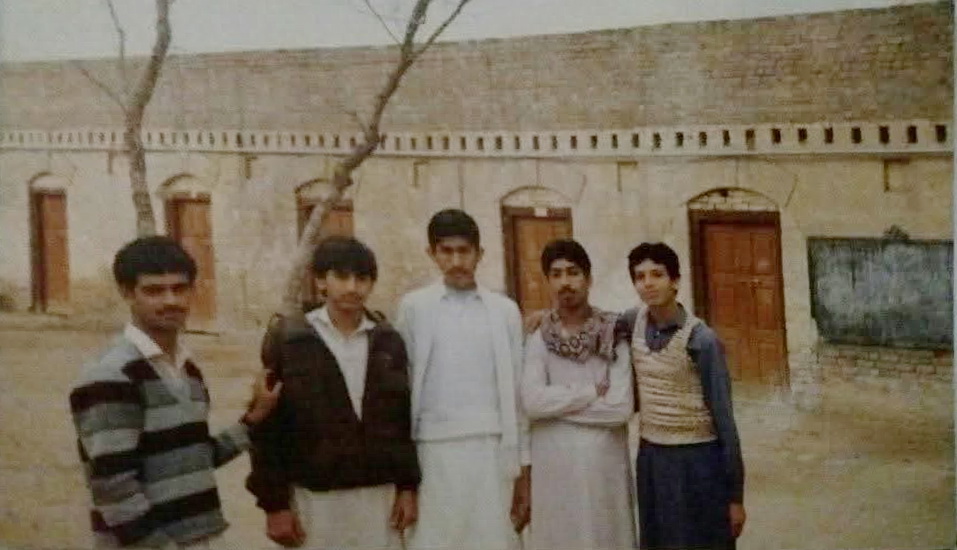
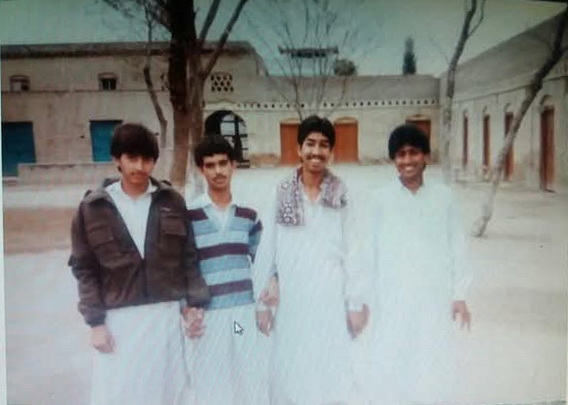
In the pictures below, Naveed Sahib is posing with his friends in 1988. In the background you can see the old building of the hostel of Munshi Sant Singh Khalsa School. Now the same building, after reconstruction is serving as the middle section of this school.
L to R: Naveed Hassan Babli (late), Naveed Ahmad Ahqar, Muhammad Farooq, Muhammad Rafaqat & Muhammad Rafiq. (1988)
L to R: Naveed Ahmad Ahqar, Naveed Hassan Babli (late), Muhammad Rafaqat & Muhammad Israr.
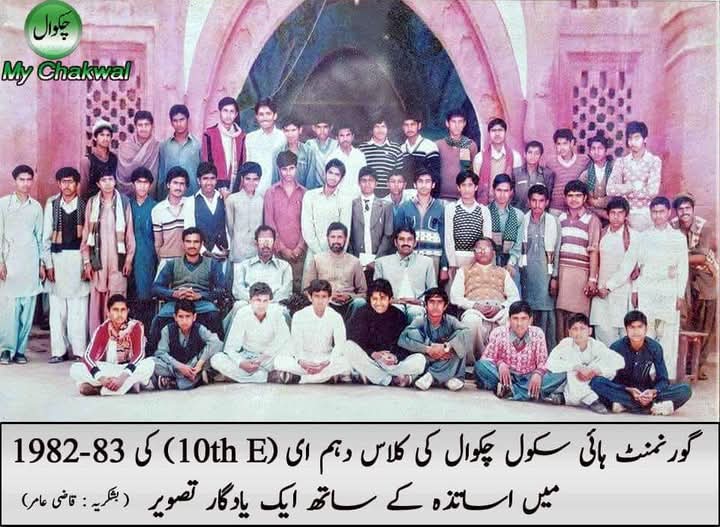
A memorable picture of the students of Class 10-E of Govt. High School Chakwal, with the teachers, 1982-83.(Picture provided by Naveed Ahmad Ahqar)
Another building related to the Khalsa School:
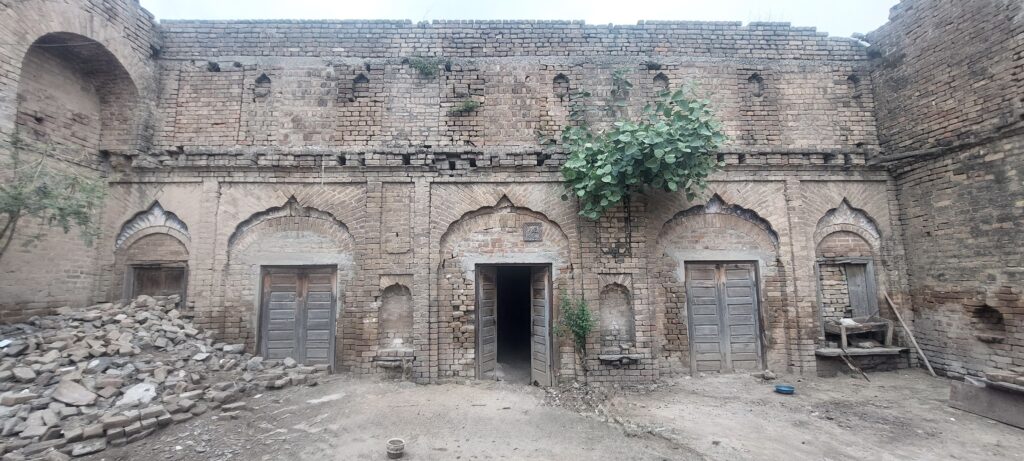
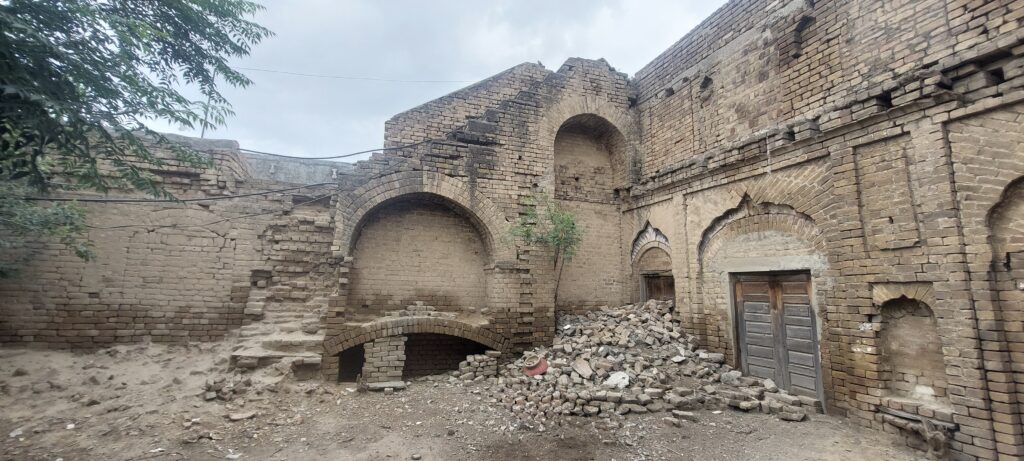
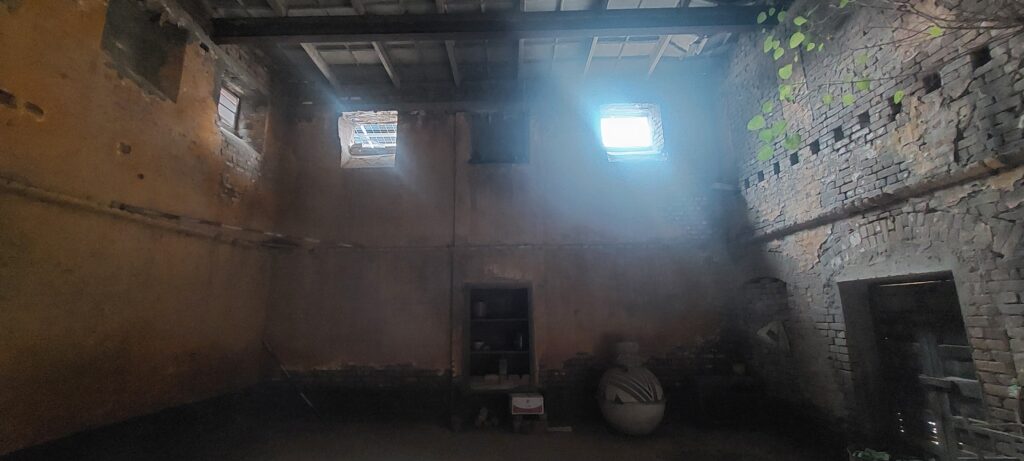
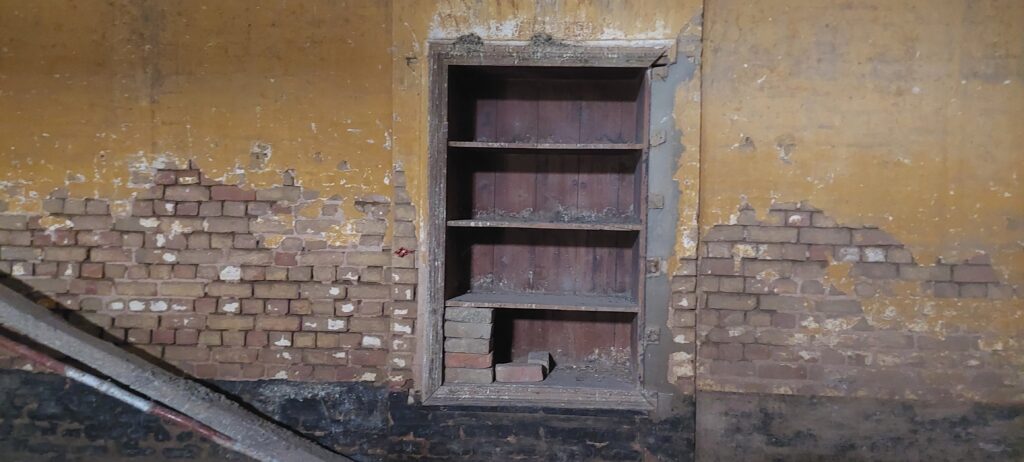
Right in front of the hostel building, another building from that time still exists. Naveed sahib informed me that this building was part of the school complex and its hall was used for sports activities. However, sports activities most probably took place during the post-partition period. Before that, in all probability, it was a gurdwara of the school, used by the students in the hostel for their prayers. However, I could not find any plaque or inscription on the building. But the hall is like many similar halls in old gurdwaras used for congregational prayers.
A view of the “Gurdwara” from the roof of the Deorhi. (14.05.2026.)Facade and courtyard of the gurdwara. (14.05.2026.)Another view of the courtyard. (14.05.2026.) Inside view of the hall. (14.05.2026.)A cupboard in the hall (14.05.2026.)
It is pertinent to clarify that several sources on the internet, particularly a couple of articles published in Dawn, confuse the concept of the Panj Piaray. The writers appear to assume that the “Five Beloved Ones” were the five devoted students of Munshi Sant Singh Ji. This is factually incorrect. The five individuals who participated in the foundation stone–laying ceremony were prominent members of the Sikh community drawn from different parts of Punjab. They were invited to perform this role in accordance with Sikh religious tradition, wherein the Panj Piaray represent the collective authority of the Khalsa. This concept has been explained in detail above.
Sardar Ratan Deep Singh:
Sardar Ratan Singh is the grandson of Sardar Chet Singh, who played a key role in the establishment of this school and also founded a school in his native village of Munde. He currently resides in Delhi and has visited Pakistan four times. What were his thoughts and feelings about these visits? Let us find them in his own words.
First Visit – 2010
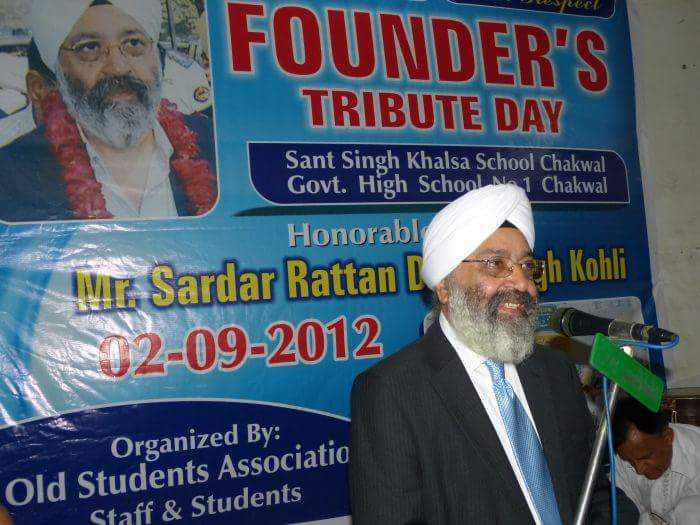
About my visits to Pakistan. My first visit was in October 2010 on the occasion of 100 years celebrations of ex SS KHALSA High School, now Govt High School no.1 in Chakwal. Principal Kiani had sent an invite to Delhi school. I made up my mind to go even though just a weeks time was there. I was overwhelmed when I reached here and got a huge welcome. But something inside me told me that I have come to my home. We were guests of Supreme Court Justice Khaleel Ramday. Stayed in Islamabad with him and next day travelled to Chakwal for celebrations in his car. Who’s who of Chakwal was there. Old and new Politicians, serving and retired Army Generals and high ranking Officers. High officials and ex students etc. Outside school traffic jam was there. It was a grand celebration. People spoke same Punjabi what my parents spoke and many remembered my grandfather S.Chet Singh. Ex headmaster who had retired many years back also came from Balkasar. Hearing names of nearby villages like Mureed, Dharma, Mainland. Dhudial, Neela, and many more looked very familiar as I use to hear all the time in my house. Memories of my parents’ wedding celebrations, which were held in School hall and the that day school function was taking place in the same hall. Tears kept swelling in my eyes and I had difficult time controlling them. Inspite of so much happening I was at peace within and felt at home. We had to leave for Islamabad soon after the function. The journey back was never ending because what we saw and celebrated along with the people of Chakwal, all the love and affection we got kept coming back. I did not sleep that night. We visited Gurdwara Panja Sahib, Nankana Sahib, Dera Sahib. Came back to India. Next few days I was stormed by relatives and friends asking me about my visit to Pakistan. How was the reaction of Pakistan people, whether we felt safe. My answer was I went to my home.
Second Visit – 2012
My second visit was in 2012 to attend wedding of our friend’s Anis and Mian Adrees Sitara children, of Faislabad Straight from Wagha border we went to Faislabad. Grand wedding attended by Pakistan’s Polticians, Industrialists, and who’s who. Celebrations took place in Faislabad and Lahore.
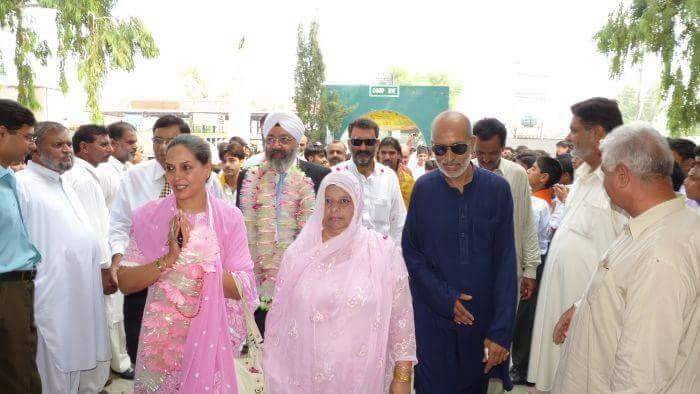
I called Principal sahib and told him I was in Pakistan with my wife for wedding and will be going to Islamabad and Muree . Other friends and family members are also accompanying. It was Sunday next day. He said you have to stop by in Chakwal and won’t take no for answer. Saturday night we reached Islamabad and next morning I hired a private car for Chakwal and left early morning. All others went to Muree. Me and my wife reached Chakwal by10.30 am. It was bigger crowd than 100years celebrations. Once again all of Chakwal was there to welcome. Dr. Kiani along with ex students put up such grand gettogether, all in one day. Chakwal group famous folk singing group and others. School students performed Ludi folkdance. and many more performances. Pictures are there. Infact an ex vice principal remarked that never before such an extensive and beautiful celebrations have been held in this school. Inspite it being a Sunday, all students attended and all eminent people of Chakwal and local press covered the program. My wife was crying most of the time overwhelmed by love and grand reception and welcome. I had requested Dr Kiani that I would like to go to Mundey as well as I could not visit first time. After the function we left for Mundey. All security clearance was taken care of. Ten cars accompanied our car. This visit was even more emotional as it was our ancestral village and S. Chet Singh was practically worshipped by the people of Mundey. He built best of school with hostel ,hospital and other facilities there. He had built a private stretch of Road so that his car could come to Mundey. Whos whoe of Mundey had come to welcome. Many told us old stories of my Grandather. How he got high school for Mundey which was to go to Balkasar. He was Kursi Nashin and also very influential with British officers. His elder brothers were given title of Rai Sahib. All people accompanying us to Mundey were also overwhelmed by such works of and respect for S.Chet Singh. I was requested by local people that I should come back to Mundey and stand for election. No candidate will stand against me. Had a great laugh but their affection showed in these words. Visited our family house which was only two and a half storey house in village when my parents and grand father left for India. It so happened that I received a call from my elder son while standing in that house. It was turned into hostel for school for long time before sold as evacuee property. My son asked where are you. I said ‘apne ghar mein’. He was confused. Again he asked where I said ‘ apne ghar mein’. Then I told him our ancestral house. While leaving I filled a bottle of water and some soil from the house and brought back to India and mixed it with plants in my house garden and watered them. I was asked at Attari border what I was carrying . I very proudly said soil and water from my house.
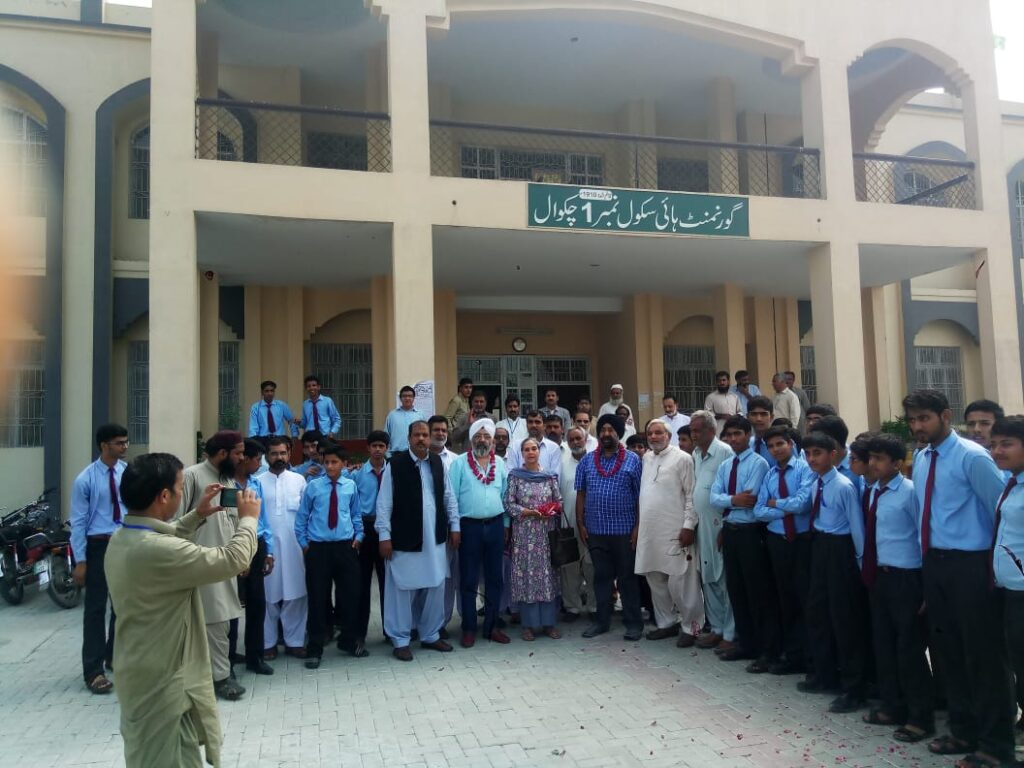
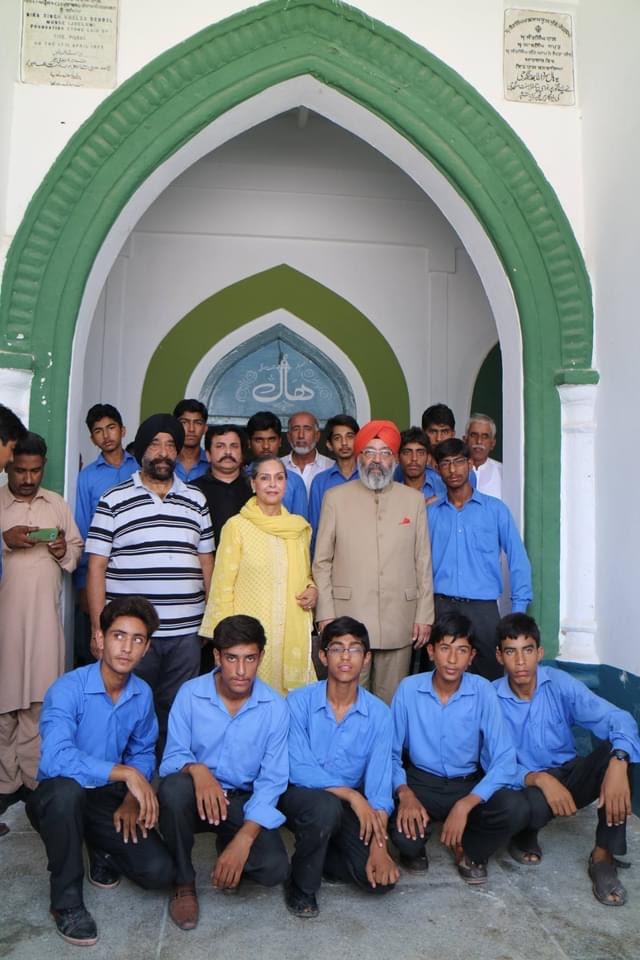
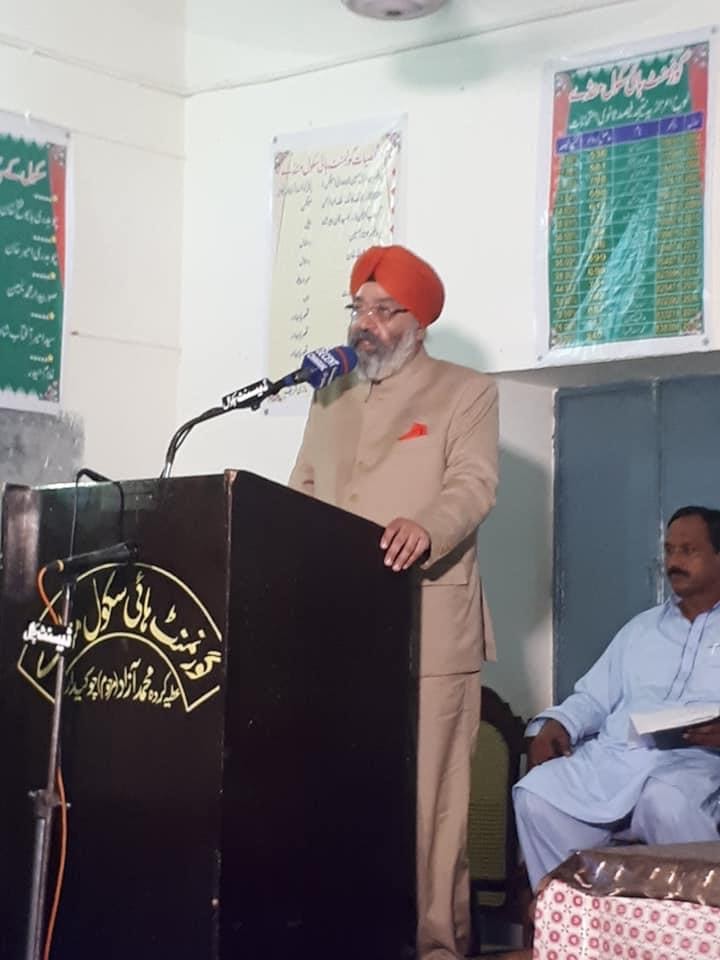
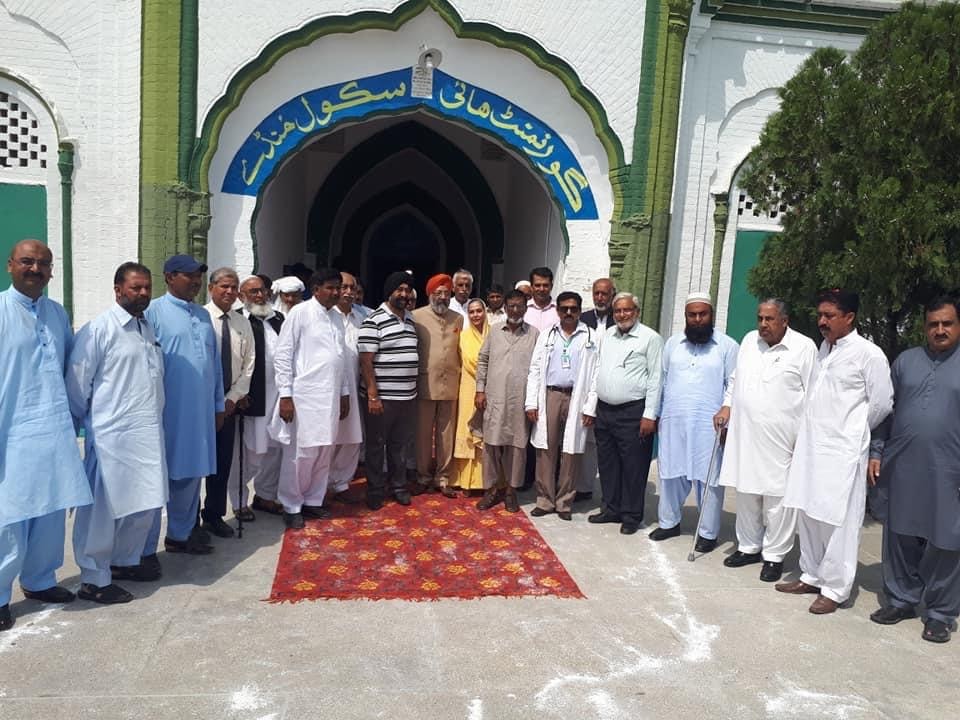
The best is when we reached back in Islamabad. The private car owner refused to taken fare. He said that experience he had during day at school and Mundey, he had never had in his entire life. Never he had seen so much love and affection for family after 65 years of independence. I forced him to take fare. He use call me and ask when I am coming again . As for other group who went Muree, when they heard the experience and saw photos. They regretted and said should have come with us to Chakwal.
Sardar Ratan Deep Singh Kohli at High School No. 1, in 2012.
Third Visit –
Sardar Ratan Singh Ji has yet to provide his account of this visit. I shall update it as soon as I receive it.
Fourth Visit – 2018
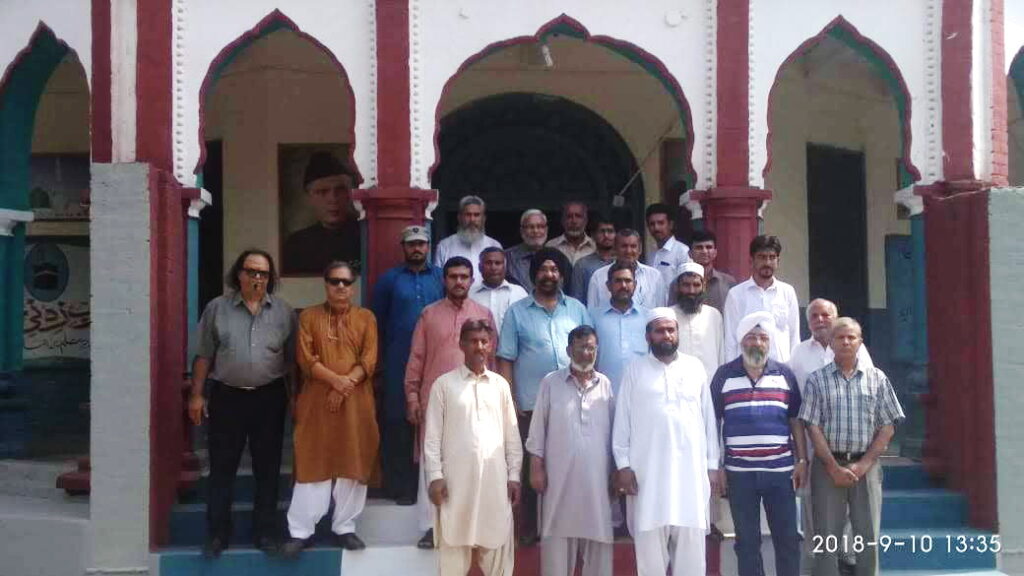
About his fourth visit in 2018, I can inform you that during this visit he visited his native village of Munde and participated in the centenary celebrations of Hira Singh Khalsa School, which was established by his grandfather in 1918. He also visited Neela with his friend Sardar Gurcharan Singh, whose grandfather, Sardar Mota Singh, had established a school there.
Sardar Ratan Deep Singh probably in Munde, in 2018.
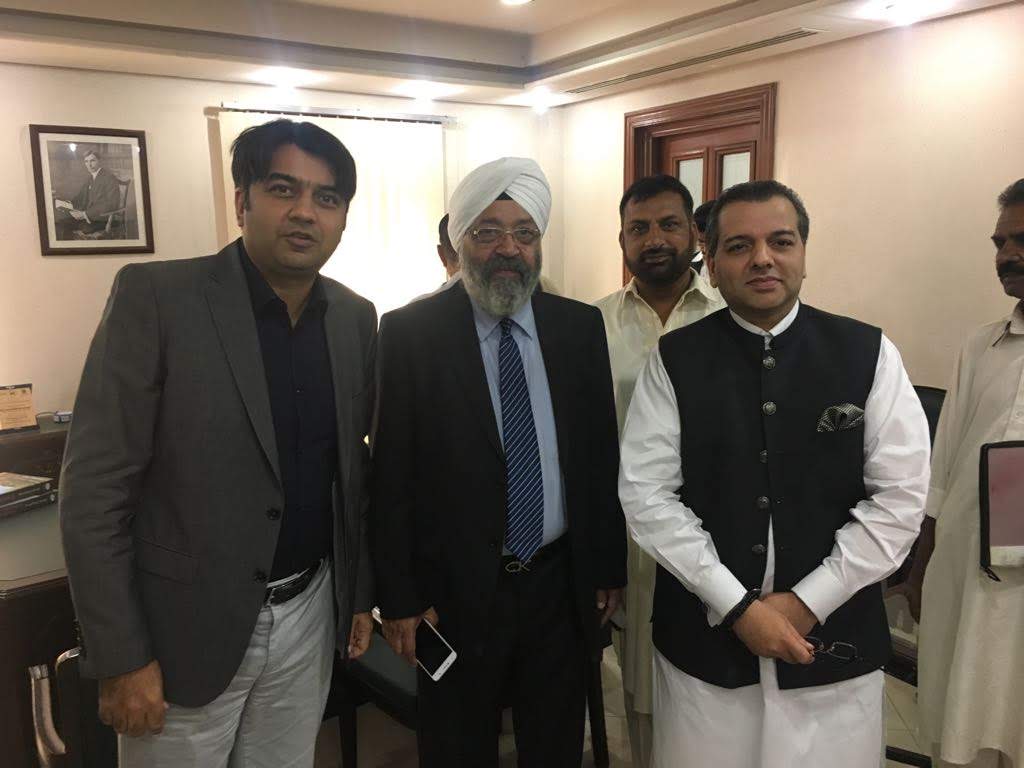
Sardar Ratan Singh with Mr Murad Ras, the Minister of Education, Punjab. 2018
Sardar Ratan Deep Singh with Sardar Gurcharan Singh* (in the centre) at Sardar Mota Singh School, Neela. 2018.
*Sardar Gurcharan Singh is the grandson of Sardar Mota Singh ji.
Visiting the Government High School No. 1. Chakwal. 2018.
The original old building of the Munshi Sant Singh Khalsa School, Chakwal.
The original old building of the Munshi Sant Singh Khalsa School, Chakwal.
The original old building of the Munshi Sant Singh Khalsa School, Chakwal.
Picture by Naveed AhmadSahib.
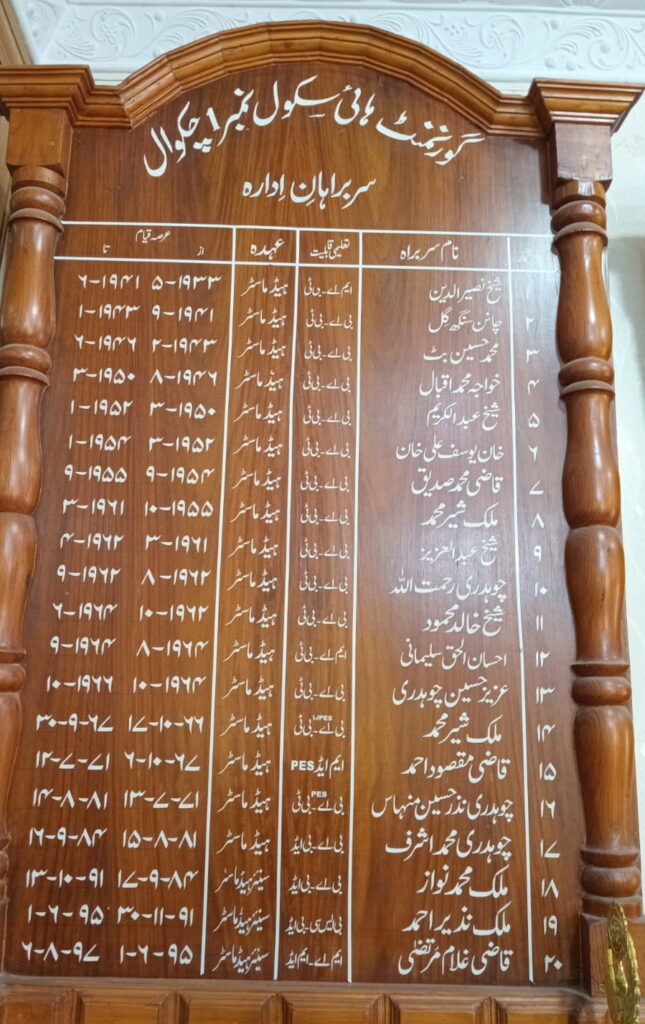
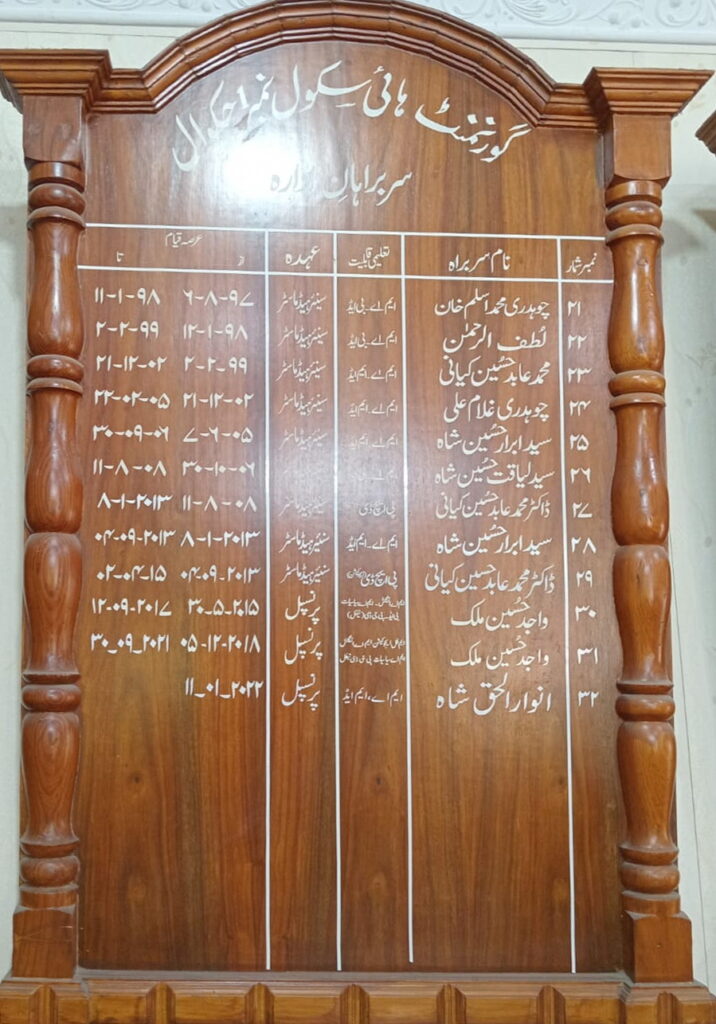
Government High School No. 1, Chakwal. Heads of Institution
Name
Qualification
Designation
Tenure
1
Sheikh Nasiruddin
M.A., B.T.
Headmaster
05.1933. – 06.1941.
2
Chann Singh Gill
B.A., B.T.
Headmaster
09.1941. – 01.1943.
3
Muhammad Hussain Butt
B.A., B.T.
Headmaster
02.1943. – 06.1946.
4
Khwaja Muhammad Iqbal
B.A., B.T.
Headmaster
08.1946. – 03.1950.
Due to some reasons, this article took me more than one month to write. But it is still far from completion. However, due to practical reasons, I cannot delay its publication any further. I shall update it as soon as possible and try to include more details about the visits of Sardar Ratan Singh to Pakistan, as well as biographical notes on Sardar Chet Singh and Sardar Harbans Singh.
2 thoughts on “225. Munshi Sant Singh Khalsa School, Chakwal. (Govt. High School No. 1 For Boys)”
Wow..! who would have thought that in a remote area like Chakwal, we still have such a beautiful and in particular well – managed historical school. Dear Tariq! your research and tireless efforts to unearth and bring history to life will be remembered both in India and Pakistan.
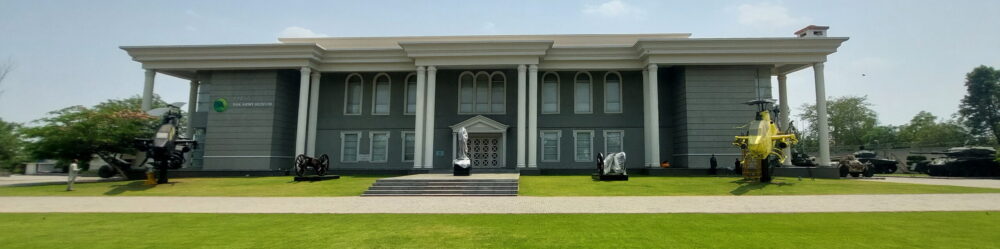

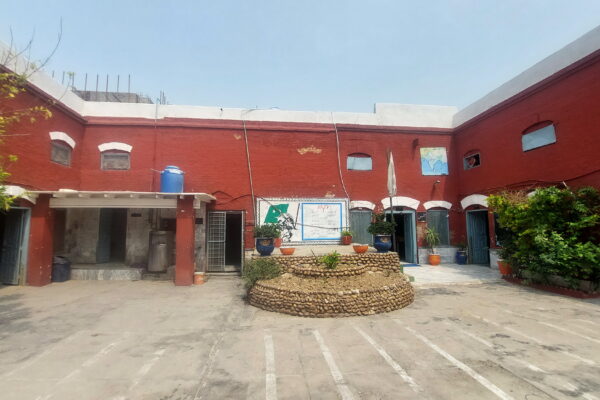
Wow..! who would have thought that in a remote area like Chakwal, we still have such a beautiful and in particular well – managed historical school. Dear Tariq! your research and tireless efforts to unearth and bring history to life will be remembered both in India and Pakistan.
Thank you very much. Your encouraging remarks are invaluable.